
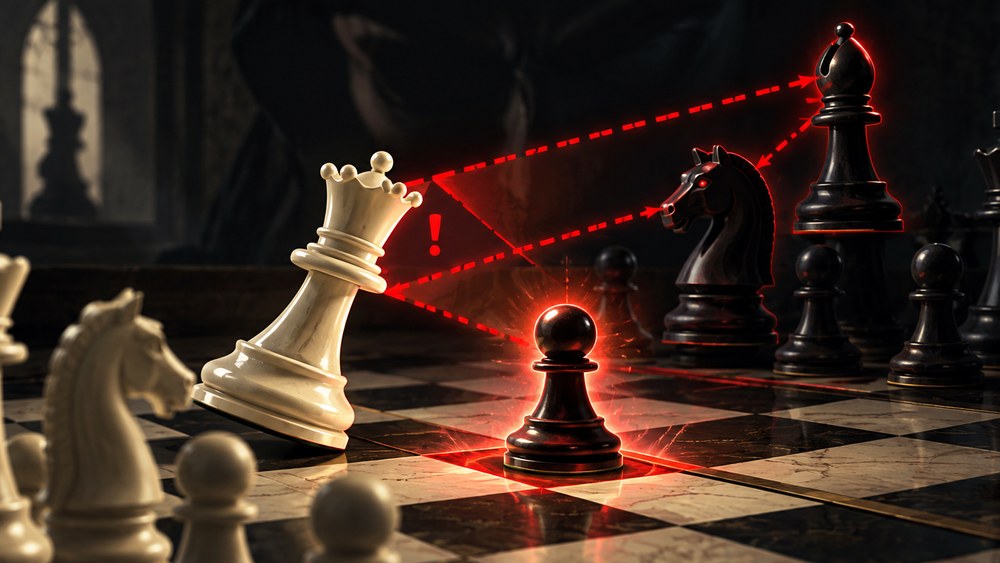
How To Avoid Chess Opening Traps?
⚠️ How To Avoid Chess Opening Traps does not require memorizing thousands of tricks. Most traps work because a player grabs material, neglects development, or overlooks a forcing reply.
Before accepting a gift, calculate the reply. Chess opening traps often exploit the same weaknesses: an exposed king, an undefended piece, or a defender that cannot move. Learn to recognise the mechanism and unfamiliar move orders become less intimidating.
⚠️ Chess opening traps: recognise the tactical warning
An opening trap is a tactical idea hidden inside a familiar move order. Good traps punish a real mistake; cheap traps fail when the opponent responds calmly. Your defense is a combination of principles and short calculation.
Whenever a move looks like a free gift, ask why the opponent allowed it. Check forcing replies before accepting material or repeating a memorized move.
🔍 When Should You Look For It?
- A pawn or piece appears free unusually early
- The opponent sacrifices material near your king
- Your queen would make several moves
- A pinned piece is your only defender
- A natural recapture opens a file or diagonal
These signs do not replace calculation, but they tell you when the position deserves extra attention. The more of them that appear together, the more likely the theme is to affect the best move.
🧭 A Step-By-Step Plan
- Finish basic development: Develop pieces and secure the king before hunting pawns.
- Question every gift: Calculate the opponent’s strongest check, capture, and threat after you take.
- Track tactical weaknesses: Loose pieces and pinned defenders make traps possible.
- Learn ideas, not sequences: Understand the tactical point so you can respond to a different move order.
- Choose a safe simplification: When uncertain, returning material may neutralize the trap.
Work through the steps in order until the process becomes natural. In a practical game, you may complete the scan in seconds because the relevant relationships are already familiar.
♟️ A Practical Example
A poisoned pawn may be safe to capture only if your queen has a route back and your king can still castle. If the capture opens a rook file or allows a development move with tempo, the extra pawn may cost several moves and lead to a direct attack.
Notice that the correct decision comes from the position’s demands rather than a slogan. Good chess principles guide your search, while concrete calculation confirms the move.
❌ Common Mistakes
- Memorizing one exact trap line
- Assuming a natural move cannot be tactical
- Trying to punish the trap immediately instead of completing development
- Refusing to return material when the king is in danger
The most dangerous mistake is using a correct idea in the wrong position. Always compare the strategic plan with immediate tactical details before committing.
🎯 A Training Method That Works
Create a notebook of traps from your own repertoire. For each one, record the warning sign, tactical motif, and safest response—not only the moves. Review the positions from the point before the mistake so recognition begins early.
Keep the exercises short enough to repeat consistently. Regular focused sessions create stronger pattern recognition than one long session followed by several weeks without practice.
✅ Quick Checklist
- Finish basic development
- Question every gift
- Track tactical weaknesses
- Learn ideas, not sequences
- Choose a safe simplification
Use this checklist during training first. With repetition, it becomes a fast internal scan that supports better decisions without consuming too much time.
♟️ Coach’s Practical Test
Review one unfamiliar opening and stop after every forcing opponent move. Ask what changed: which piece became loose, which line opened, and whether your intended recapture still works. Write one safe developing alternative before checking theory.
Build a small trap notebook that records the tactical mechanism instead of memorizing a long move sequence. Pins, overloaded defenders, and premature queen adventures repeat across openings. Understanding the mechanism lets you avoid the trap even when the exact position arrives through a different move order.
♟️ Chess opening traps: a concrete warning on f7
Consider 1.e4 e5 2.Qh5 Nc6 3.Bc4. White’s queen and bishop both attack f7. The developing move 3…Nf6? attacks the queen but allows 4.Qxf7#. A natural-looking move has failed because it ignored a more urgent threat.
Before choosing Black’s third move, identify that threat. For example, 3…g6 attacks the queen while blocking its diagonal towards f7. White still has moves and Black must continue developing sensibly; avoiding one trap does not end the opening.
The lesson is not to fear early queen moves. It is to compare threats in the right order. Attacking the queen does not help if your opponent can give checkmate first. Apply the same test whenever a move wins material or gains a tempo: what forcing reply becomes available?
Build your trap notebook around three questions: what was the warning sign, which move failed, and what safe alternative addressed the real threat? Save the position before the mistake, not only the final mating picture.
💬 Questions about avoiding chess opening traps
Should I memorise every trap in my opening?
Start with recurring tactical ideas in the positions you actually reach. Learn why the trap works and how your normal development changes the calculation. A small, well-understood collection is more useful than a long list of moves you cannot explain.
Is declining a pawn always safer?
No. Some offers are unsound and can be accepted. Calculate checks, captures and threats after taking, and make sure the capturing piece has a safe route. Declining material without understanding the position can also give away an advantage.
What should I do when I cannot remember the line?
Return to the board: king safety, loose pieces, pinned defenders and the opponent’s direct threat. Find a developing move that addresses the concrete danger. Do not reproduce a half-remembered continuation simply because its first move looks familiar.
Study overloaded defenders and development advantages to recognise the mechanisms behind many traps. The opening category in Lichess puzzle themes provides additional practice positions.
Final Thoughts
Avoid opening traps by developing, questioning free material, and calculating forcing replies. Learn the tactical idea behind each trap so a new move order does not surprise you.
🌟 Improvement comes from recognizing the right moment, following a clear process, and reviewing the result honestly. Apply the idea in your own games until it becomes part of your natural thinking.

You may also like

How to Study a Chess Course: 5 Easy Steps

How To Play Gambit Positions In Chess?