
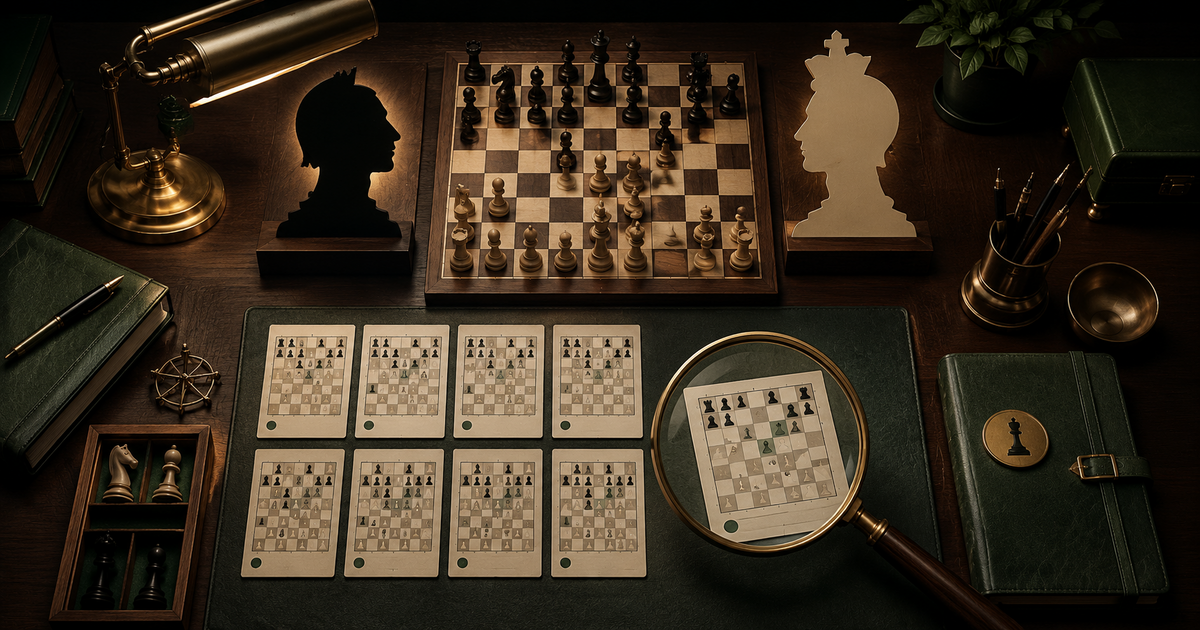
How To Prepare For A Specific Chess Opponent?
Preparing for a specific opponent is the process of turning public game information into a practical plan for one game. It includes opening choices, recurring structural preferences, time-management habits, and the kinds of decisions the opponent handles well or poorly. 🔎 Good preparation is focused enough to remember and flexible enough to survive a surprise.
The goal is not to predict every move. 🎯 It is to increase the chance of reaching a position you understand, with one or two prepared details that are genuinely relevant.
Confirm Color And Likely Repertoire
Begin with the side you will play and collect the opponent’s recent serious games in the relevant openings. Recent games matter more than old games because repertoires evolve.
🗂️ Separate repeated choices from one-time experiments. A move played five times is a stronger signal than a sideline used once.
Find The Earliest Useful Decision Point
Look for the first position where you have two sound options and one may be less comfortable for the opponent. Preparing at move eight is usually more practical than searching for a novelty at move twenty-five.
🔀 Choose a branch that fits your repertoire so the preparation remains useful even if the opponent deviates.
Study Structures, Not Only Results
An opponent may score well because of weak opposition or lose after reaching a position they actually understand. Watch how they place pieces, choose pawn breaks, and handle typical exchanges.
🧭 The quality of their decisions is more informative than the final score alone.
Identify Recurring Practical Tendencies
Some players spend too much time early, avoid queen exchanges, attack whenever possible, or defend patiently but passively. Treat these as tendencies, not guarantees.
⏱️ Build a plan that remains objectively sound even if the tendency does not appear.
Prepare The Opponent’s Best Response
Do not base the plan on the move you hope they will play. Use an engine and strong reference games to test your line against the best defense.
🛡️ If the preparation is sound against the strongest reply, it will remain useful against weaker alternatives.
Create A Compact Game-Day File
Reduce the work to a short move tree, two or three model positions, the main pawn break, and one tactical warning. Review the file, then close it before the round.
📝 Overloading memory immediately before a game can make you less flexible when the position changes.
Have A Plan For The Surprise
Assume the opponent may deviate early. Decide in advance that you will return to sound development, use your normal thinking process, and avoid spending excessive time trying to remember a line that is no longer relevant.
🧘 Preparation should create confidence, not dependence.
A Ninety-Minute Preparation Workflow
Limit the session so research does not expand without improving the plan.
- Spend twenty minutes collecting recent relevant games.
- Spend twenty minutes identifying repeated openings and structures.
- Spend twenty-five minutes testing one practical branch.
- Spend fifteen minutes studying two model positions.
- Spend ten minutes compressing everything into a one-page file.
⏰ For important events you can go deeper, but the same order keeps the work focused.
Quick Checklist
- Am I using recent games with the correct color?
- What choice has the opponent repeated?
- Where is the earliest useful branch for me?
- What structures and exchanges do they prefer?
- Is my line sound against the best response?
- Can the final file fit on one page?
- What will I do if they surprise me?
Common Mistakes
The classic mistake is preparing too deeply in one narrow line and feeling disappointed when the opponent deviates. The unused work then becomes a psychological burden.
❌ Another error is choosing an objectively inferior opening only because the opponent once lost to it. Preparation should exploit comfort while preserving the quality of your own position.
Continue Your Training
For practical guidance on tournament preparation, pre-game routines, clock use, and handling competitive pressure, explore Practical Advices During The Tournament.
Final Thoughts
Opponent preparation should produce one clear, sound game plan. Use recent evidence, target an early decision point, study structures and tendencies, test the best defense, and compress the result.
🌟 The strongest preparation helps you reach your kind of chess—then leaves you free to think.

You may also like

How to Study a Chess Course: 5 Easy Steps

How To Play Gambit Positions In Chess?