
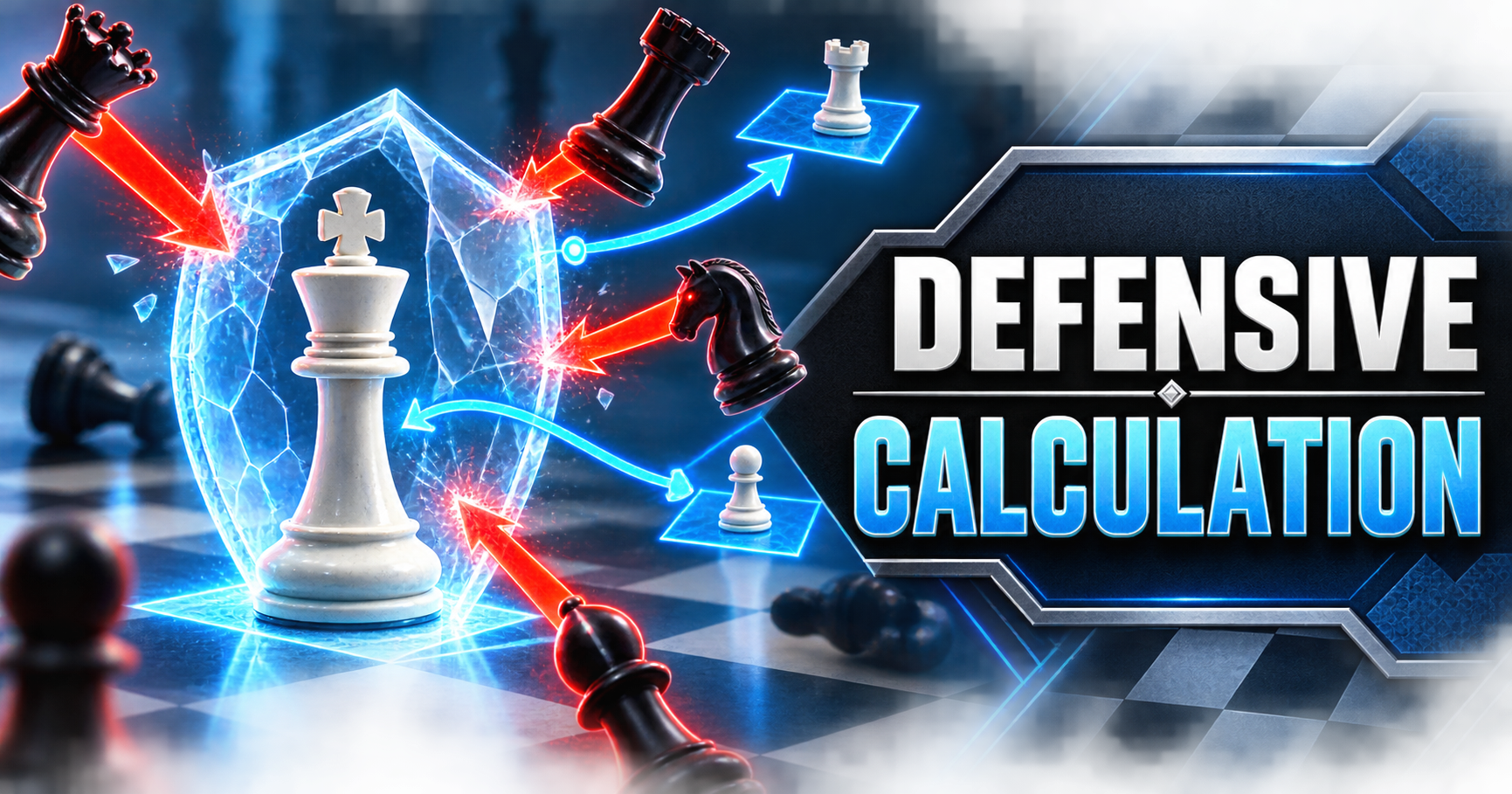
Defensive Calculation in Chess: 10 Powerful Steps
Defensive calculation in chess is not passive survival—it is the skill of finding the opponent’s real threat and choosing the reply that makes their task hardest. 🛡️ Strong defense often begins with one calm, accurate move.
⚡ Reliable defensive calculation in chess begins by resisting the urge to calculate only the move you fear most. A better process generates several defensive resources, checks the opponent’s strongest continuation, and compares the resulting positions objectively.
Table of Contents
Name The Threat Precisely
Before calculating, describe what the opponent wants. Is the threat mate, material gain, a tactical entry, a pawn break, or simply a favorable exchange?
🔍 A vague feeling of danger produces vague moves. A precise statement—such as “…Qh2 is mate unless I create luft or trade queens”—immediately narrows the search.
Check Forcing Moves For Both Sides
Start with checks, captures, and direct threats, but do not examine them mechanically. Ask whether your forcing move changes the initiative or merely delays the danger.
♟️ Counterchecks, intermediate moves, and tactical exchanges are common defensive resources. The Calculation & Evaluation Technique course develops this disciplined candidate scan.
Generate More Than One Defensive Candidate
The first move that prevents the threat may be ugly or overly passive. Look for at least three types of defense: direct protection, simplification, and active counterplay.
🧰 Include quiet moves that create an escape square, unpin a piece, or remove an attacker. Defensive brilliance is often less visible than an attacking combination.
Remove The Most Important Attacker
Trading one key attacking piece can collapse the entire combination. Identify which enemy piece supplies the final blow, protects an entry square, or prevents your king from escaping.
✂️ Do not exchange automatically. Compare what remains afterward: sometimes removing a minor piece matters more than trading queens, and sometimes a queen trade leads to a lost ending.
Defend The Critical Square
Many attacks depend on one invasion square or tactical contact point. Rather than trying to protect everything, reinforce or evacuate the square the combination actually needs.
🧱 The The Art Of Defense course shows how restriction, coordination, and timely simplification work together in difficult positions.
Calculate The Opponent’s Best Reply
Do not stop when your candidate appears to solve the first threat. Assume the opponent sees your idea and search for their strongest continuation, including sacrifices and move-order changes.
🧠 Use a minimax mindset: for each defensive candidate, find the most dangerous legal reply. Your chosen move should survive that test, not just the line you hope they play.
Know When To Return Material
A material advantage is irrelevant if your king is mated or your pieces remain trapped. Returning an exchange, pawn, or piece may eliminate the attack and leave a defensible position.
⚖️ Evaluate the position after the sacrifice: king safety, activity, pawn structure, and remaining material all matter. The smallest sufficient concession is usually best.
Create Counterplay Without Losing Control
Active defense forces the attacker to solve problems. A passed pawn, attack on the queen, central break, or threat against the king may gain the tempo you need.
🔥 Counterplay must be concrete. If it ignores a forced mate, it is wishful thinking; if it interrupts the opponent’s move order, it can completely change the game.
Stay Calm In Worse Positions
Defensive calculation in chess also depends on emotional resistance because panic shortens the search. Accept that the position may be worse, then search for the line with the greatest practical resistance.
🧭 The Master Chess Strategy course helps evaluate concessions and choose the defensive structure with the best long-term chances.
A Defensive Calculation Checklist
- What is the exact threat?
- Which forcing moves are available to both sides?
- Can I trade the key attacker?
- Can I defend or evacuate the critical square?
- Is there a quiet defensive resource?
- Would returning material end the attack?
- What is the opponent’s best reply to my candidate?
- Which line gives the greatest practical resistance?
✅ Run the checklist before committing to a desperate move. A structured scan keeps fear from hiding the strongest resource.
How To Train Defensive Calculation in Chess
Take tactical positions from the defender’s side and give yourself a realistic clock. Write down three candidate moves before calculating, then save the position in a Lichess Study and compare your final choice with analysis.
🎯 After each exercise, classify the saving idea: simplification, counterattack, interference, escape square, material return, or pure calculation. Patterns become much easier to retrieve when they have names.
Defensive Calculation in Chess: FAQs
What should I calculate first when defending?
State the exact threat, then scan checks, captures, and direct threats for both sides. This separates urgent tactical problems from moves that merely look dangerous.
How many defensive candidates should I consider?
In a critical position, try to compare at least a direct defense, a simplifying move, and an active resource. The clock may limit your search, but relying on the first legal defense is risky.
When should I return material?
Return material when the resulting position removes the attack or creates a clearly more resilient defense. Calculate the smallest sufficient concession and evaluate the position after the exchange.
How can I train defensive calculation?
Solve positions from the defender’s side, write down multiple candidates, and test each against the opponent’s strongest reply. Classify the saving mechanism so the pattern becomes easier to recognize later.
Final Thoughts
Improving defensive calculation in chess means replacing panic with a repeatable process: define the threat, generate resilient candidates, and test each one against the opponent’s best response.
✨ A difficult position does not demand a miracle. It demands the move that keeps the fight alive.

You may also like

How to Study a Chess Course: 5 Easy Steps
Gambit Positions in Chess: 5 Keys to Strong Compensation