
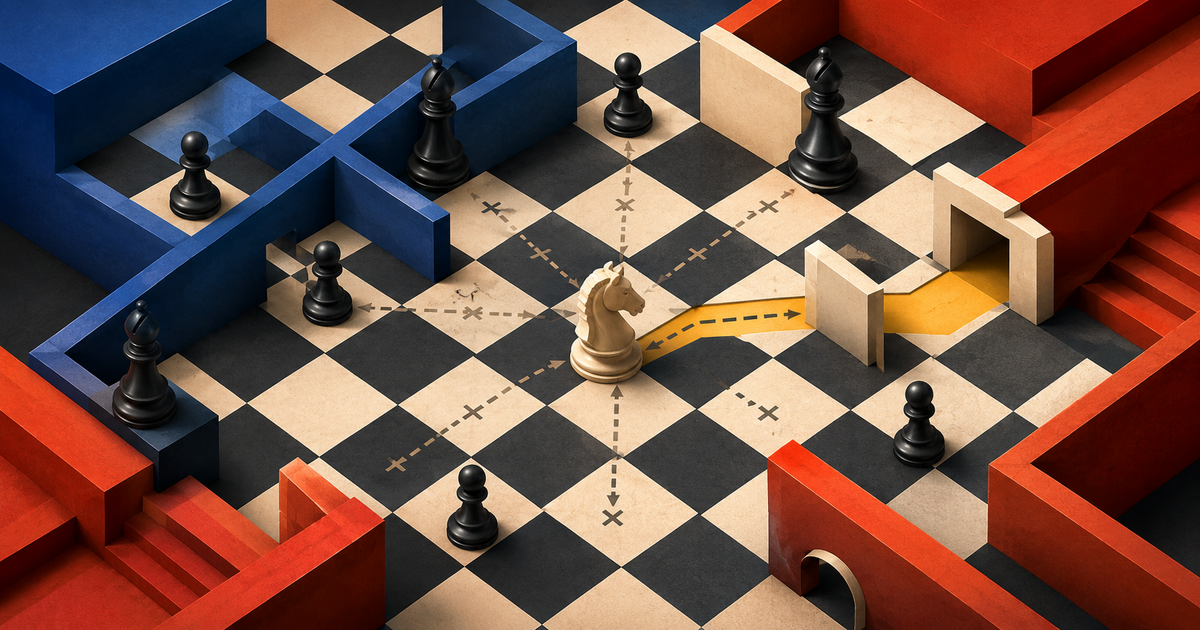
How To Use Restriction In Chess Strategy?
Restriction is the art of reducing the opponent’s useful moves before beginning your own active operation. A restricted piece may have legal squares but no productive role; a restricted pawn break may exist but fail tactically. 🔒 The position becomes easier to play because the opponent’s counterplay disappears.
Effective restriction is specific. 🎯 You are not trying to control every square—only the route, break, or exchange that would free the opponent’s position.
Identify The Opponent’s Liberating Break
Most cramped positions depend on one pawn break such as …c5, …e5, f4, or b5. Determine what prepares it and what pieces become active afterward.
🧱 Block the break, control its destination, or make the resulting exchange unfavorable.
Take Away The Best Square
A single square can organize the opponent’s entire position. A pawn move or minor-piece placement that controls it may force a long and awkward reroute.
🚫 Focus on useful squares, not empty territory. Denying an attractive square matters only if the piece lacks an equally good alternative.
Preserve The Piece That Maintains The Bind
A knight, bishop, or pawn may be doing more than it appears by controlling a break and several entry squares. Exchanging it can release the opponent even if the trade looks favorable by ordinary rules.
🛡️ Before exchanging, ask which enemy move becomes possible when your restraining piece disappears.
Fix Targets Before Attacking Them
A pawn is easiest to attack when it cannot advance or exchange. First restrict its movement, then bring pieces toward it.
📌 Fixing a target removes the defender’s most natural solution and gives your maneuver time to succeed.
Improve Slowly Behind The Barrier
Once counterplay is controlled, improve the least active piece, create a second weakness, or prepare a breakthrough. There is no need to rush while the opponent has no useful freeing move.
🔧 Use the time to place every piece on its ideal square before changing the structure.
Watch For Tactical Breakouts
A strategically restricted opponent may sacrifice material to open lines. Calculate exchanges and pawn breaks that seem positionally undesirable but create immediate tactics.
⚠️ A bind is strong only if its tactical foundation is sound.
Convert Restriction Into A Concrete Gain
Restriction is a phase, not the final objective. Eventually use it to win a pawn, invade with a rook, create a passed pawn, or launch an attack on the wing the opponent cannot defend.
🚪 Open the position on your terms after the opponent’s pieces have been placed badly.
The Freedom Test
For a strategic position, imagine the opponent receives one free move and can play anything legal.
- Choose the move that would improve their position most.
- Identify the break, square, or piece route behind that move.
- Find one move that prevents it without weakening your position.
- Repeat the test after your restraining move.
- When no urgent freeing move remains, improve your worst piece.
🔍 This exercise turns prophylaxis into a concrete search rather than a vague defensive mood.
Quick Checklist
- What is the opponent’s liberating pawn break?
- Which square organizes their pieces?
- Which of my pieces maintains the bind?
- Can the target advance or exchange?
- Is there a tactical breakout?
- What concrete gain will the restriction produce?
Common Mistakes
Restriction can become aimless if you keep preventing moves that the opponent no longer wants to play. Re-evaluate after each structural change.
❌ Another mistake is confusing restriction with passivity. Your pieces should become more active while the opponent’s options shrink, and the bind should eventually support a breakthrough.
Continue Your Training
For deeper study of prophylaxis, strategic binds, weak squares, and the conversion of restricted positions, use Master Chess Strategy.
Final Thoughts
Restriction works by identifying the opponent’s route to freedom and closing it efficiently. Stop the break, deny the key square, preserve the restraining piece, and improve behind the barrier.
🌟 When the opponent cannot improve, even a small advantage gains time to grow into something concrete.

You may also like

How to Study a Chess Course: 5 Easy Steps

How To Play Gambit Positions In Chess?