
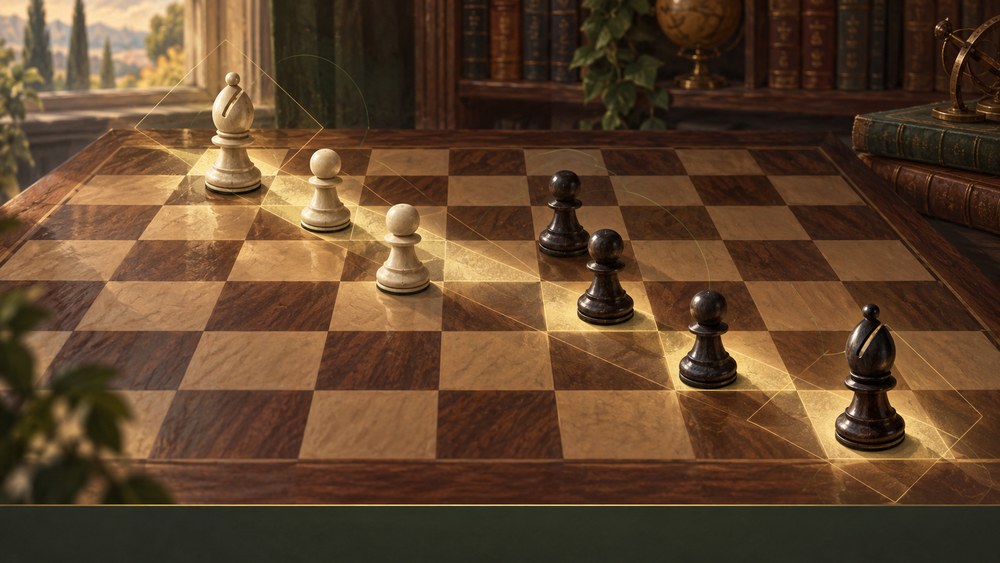
How To Play Same-Colored Bishop Endgames?
♗ How To Play Same-Colored Bishop Endgames depends on king activity, pawn placement, and control of a single color complex. Unlike opposite-colored bishop endings, an extra pawn is often meaningful because both bishops can directly fight over the same key squares.
Study the targets and the king routes together. In same-colored bishop endgames, an active bishop may tie down the opponent while the king enters elsewhere. The winning plan usually needs both pieces; attacking one pawn repeatedly may achieve nothing.
♗ Same-colored bishop endgames: coordinate king and bishop
The stronger bishop attacks enemy pawns while defending its own on the relevant color. Pawns fixed on the bishop’s color can become targets, especially when the king can approach.
A good bishop is active on both wings. Centralize the king, avoid unnecessary pawn moves, and calculate whether a bishop trade leads to a favorable pawn ending.
🔍 When Should You Look For It?
- Several pawns are fixed on one color
- One bishop has a clear diagonal across both wings
- A king can enter through a weak square
- A bishop exchange changes the pawn ending
- A passed pawn can distract the defending bishop
These signs do not replace calculation, but they tell you when the position deserves extra attention. The more of them that appear together, the more likely the theme is to affect the best move.
🧭 A Step-By-Step Plan
- Improve the king: King activity usually determines whether a small advantage can grow.
- Fix targets: Place enemy pawns on squares your bishop can attack.
- Keep your bishop flexible: Avoid trapping it behind your own pawn chain.
- Create a second wing: One bishop cannot defend separated weaknesses indefinitely.
- Calculate bishop trades: Exchange only when the resulting king-and-pawn ending is favorable.
Work through the steps in order until the process becomes natural. In a practical game, you may complete the scan in seconds because the relevant relationships are already familiar.
♟️ A Practical Example
If both bishops operate on dark squares, a weak dark-square pawn can be attacked directly. The defender may protect it, but that tie can let the stronger king enter elsewhere. A passed pawn on the opposite wing often becomes the decisive distraction.
Notice that the correct decision comes from the position’s demands rather than a slogan. Good chess principles guide your search, while concrete calculation confirms the move.
❌ Common Mistakes
- Putting pawns on the same color as the enemy bishop without reason
- Trading bishops automatically when ahead
- Ignoring king activity because the bishops remain
- Pushing a passed pawn until it becomes blockaded
The most dangerous mistake is using a correct idea in the wrong position. Always compare the strategic plan with immediate tactical details before committing.
🎯 A Training Method That Works
Take five same-colored bishop endings and play each from both sides. Before every pawn move, ask which squares become permanently weak. Before every bishop trade, calculate the pawn ending to a clear result.
Keep the exercises short enough to repeat consistently. Regular focused sessions create stronger pattern recognition than one long session followed by several weeks without practice.
✅ Quick Checklist
- Improve the king
- Fix targets
- Keep your bishop flexible
- Create a second wing
- Calculate bishop trades
Use this checklist during training first. With repetition, it becomes a fast internal scan that supports better decisions without consuming too much time.
♟️ Coach’s Practical Test
Take a same-colored bishop endgame and mark every pawn fixed on the bishops’ color. Identify which side can attack those pawns without allowing an active king entry. Then compare a bishop trade with keeping both bishops on the board.
Your plan should name a concrete second weakness, not merely “improve the king.” These endings reward precise target creation: force one pawn to be defended, switch wings, and only then calculate a favorable exchange into a king-and-pawn ending.
♟️ Test exchanges in same-colored bishop endgames
Choose a position where your bishop attacks a pawn and the opposing bishop defends it. First ask whether your king can improve while the enemy bishop remains tied down. Repeating the same bishop attack is not progress unless it changes the defender’s available moves.
Look for a second target on the other wing. Name the route your bishop would use to switch the attack, and check whether moving away releases an enemy passed pawn. Two weaknesses help only when your pieces can attack them without giving the defender stronger counterplay.
Before exchanging bishops, calculate the king-and-pawn ending separately. Who moves first after the exchange? Which king reaches an entry square? Can a pawn move gain or lose a tempo? Do not carry the evaluation of the bishop ending into a completely different type of position.
For a useful comparison exercise, replay the same position with the stronger king one square less active, provided the setup remains legal. Notice how that change affects the bishop trade and the ability to attack a second weakness. This isolates the importance of king activity.
💬 Same-colored bishop endgames: common questions
Should my pawns always stand opposite my bishop’s colour?
It is a useful starting consideration, not an absolute rule. Keeping your bishop’s diagonals clear can improve activity, but a particular pawn move may be needed to restrain a passer or stop the enemy king. Calculate the concrete purpose before applying a slogan.
Is an active bishop enough to win?
No. The defender may cover the only target comfortably. Ask how the king can enter, whether another weakness can be created and whether a favourable exchange is available. Activity needs a way to produce something tangible.
How can the weaker side resist?
Keep the king active, avoid fixing new targets unnecessarily and look for exchanges that lead to a drawn pawn ending. Sometimes the best defence is to create counterplay rather than protect every pawn from a passive square.
Continue with converting an extra pawn and drawing difficult positions. For supplementary exercises, choose the bishop-endgame category in Lichess puzzle themes.
Final Thoughts
Same-colored bishop endings reward active kings, flexible bishops, and well-timed pawn fixing. Create two targets and calculate every bishop exchange with care.
🌟 Improvement comes from recognizing the right moment, following a clear process, and reviewing the result honestly. Apply the idea in your own games until it becomes part of your natural thinking.

You may also like

Basic Checkmates in Chess: 5 Easy Steps to Confident Wins

How To Practice Blindfold Chess?