
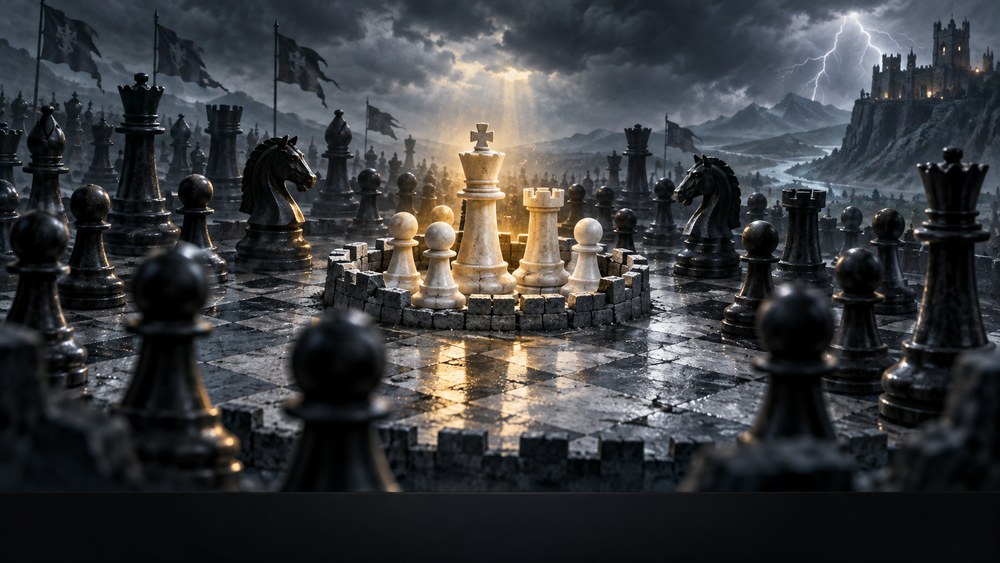
How To Hold A Draw In A Difficult Chess Position?
🛡️ How To Hold A Draw In A Difficult Chess Position is about finding the opponent’s hardest winning task rather than searching for a perfect position. Active resistance, simplification, and well-chosen fortresses can save positions that look hopeless.
Make the opponent solve the hardest remaining problem. To hold a draw, you need a concrete defensive idea: useful checks, a blockade, a favourable exchange or a position the opponent cannot improve. Passive waiting is only useful when you know why the setup holds.
🛡️ Hold a draw by identifying the opponent’s winning plan
Defensive play begins by identifying what the stronger side still needs: a king entry, a pawn break, an exchange, or a second weakness. Your moves should prevent that plan or make it costly.
A draw may be reached through repetition, stalemate, a dead position or a fortress the opponent cannot break. Exchanging all the pawns is not enough by itself: a rook or queen can still give mate without pawns. Evaluate the actual position that remains.
🔍 When Should You Look For It?
- The opponent has only one clear entry point
- Checks can force repetition
- Exchanges reduce the number of weaknesses
- A stable blockade is possible
- A pawn sacrifice can reach a known drawn ending
These signs do not replace calculation, but they tell you when the position deserves extra attention. The more of them that appear together, the more likely the theme is to affect the best move.
🧭 A Step-By-Step Plan
- Name the winning plan: Understand what the opponent needs before choosing a defensive move.
- Seek activity: Counterchecks and attacks on pawns are usually better than passive waiting.
- Trade the right pieces: Remove the opponent’s most active piece while preserving your drawing resources.
- Build a fortress: Control entry squares and avoid pawn moves that weaken the setup.
- Set practical problems: Choose lines that require precise decisions instead of easy technical play.
Work through the steps in order until the process becomes natural. In a practical game, you may complete the scan in seconds because the relevant relationships are already familiar.
♟️ A Practical Example
When down a pawn in a rook ending, placing the rook behind the enemy passer may create checks and force the king to shelter. Passive side defense can lose slowly, while active checks may keep the king from making progress forever.
Notice that the correct decision comes from the position’s demands rather than a slogan. Good chess principles guide your search, while concrete calculation confirms the move.
❌ Common Mistakes
- Trading pieces without checking the pawn ending
- Defending every pawn and losing all activity
- Making unnecessary pawn moves inside a fortress
- Resigning before testing the opponent’s technique
The most dangerous mistake is using a correct idea in the wrong position. Always compare the strategic plan with immediate tactical details before committing.
🎯 A Training Method That Works
Play difficult endings against an engine from the weaker side and give yourself a concrete drawing goal: reach a rook-behind-pawn setup, exchange one wing, or construct a blockade. Review only the moments where the evaluation changed; these are your defensive decision points.
Keep the exercises short enough to repeat consistently. Regular focused sessions create stronger pattern recognition than one long session followed by several weeks without practice.
✅ Quick Checklist
- Name the winning plan
- Seek activity
- Trade the right pieces
- Build a fortress
- Set practical problems
Use this checklist during training first. With repetition, it becomes a fast internal scan that supports better decisions without consuming too much time.
♟️ Coach’s Practical Test
Choose a worse position and list the opponent’s two cleanest winning plans. Build your defense around disrupting those plans rather than protecting every weakness. Compare active counterplay, a simplifying exchange, and a fortress attempt.
Set a five-minute clock and defend the position against an engine at reduced strength, then review only the first move that changed the evaluation decisively. Strong practical defense grows from finding the hardest problem for the opponent, preserving useful pieces, and recognizing when simplification helps the wrong side.
♟️ Test the plan you need to hold a draw
Begin with a worse position from one of your games. Write the opponent’s simplest winning plan in one sentence: bring the king into the centre, create an outside passer, or exchange into a favourable pawn ending. Now compare three defensive candidates against that plan.
An active move might give checks or attack a pawn. A simplifying move might remove the strongest attacking piece. A waiting move might preserve a blockade. None is automatically best; calculate what the stronger side can do after each one.
In a rook ending, for example, defending a pawn passively may leave the enemy king free to improve. Active checks could offer better resistance, but first verify the checking distance, shelter squares and safety of your own king. The slogan ‘activate the rook’ cannot replace those details.
Before trading rooks, set up the resulting pawn ending in your mind. Which king reaches the important squares first? Can either side create a passed pawn? A trade that removes immediate pressure can still turn a defensible rook ending into a lost pawn ending.
💬 Questions about how to hold a draw
How do I know whether a fortress really works?
Try to break it from the stronger side. Look for a pawn sacrifice, a change of move order, zugzwang or a second entry point. A position that feels hard to win is not necessarily a fortress. Your defensive claim needs a concrete answer to the opponent’s improving plans.
Should I sacrifice a pawn to become active?
Consider it when the sacrifice creates a real drawing mechanism or strong counterplay. Compare the resulting position with passive defence. Do not sacrifice solely because the current position is uncomfortable.
What should I practise after a failed defence?
Find the first move that abandoned a useful resource. Replay from that position and test a different plan. If the ending is within the range of an available tablebase, use it to check the result; otherwise investigate the key defensive lines carefully.
The Lichess practice section includes rook-ending lessons. Connect defensive technique with understanding the stronger side’s extra-pawn plan and resetting after a mistake.
Final Thoughts
Holding a difficult position requires active resistance and a clear idea of the opponent’s winning plan. Preserve counterplay, simplify selectively, and recognize drawing mechanisms early.
🌟 Improvement comes from recognizing the right moment, following a clear process, and reviewing the result honestly. Apply the idea in your own games until it becomes part of your natural thinking.
Tag:Chess Defense

You may also like
Basic Checkmates in Chess: 5 Easy Steps to Confident Wins

How To Practice Blindfold Chess?