
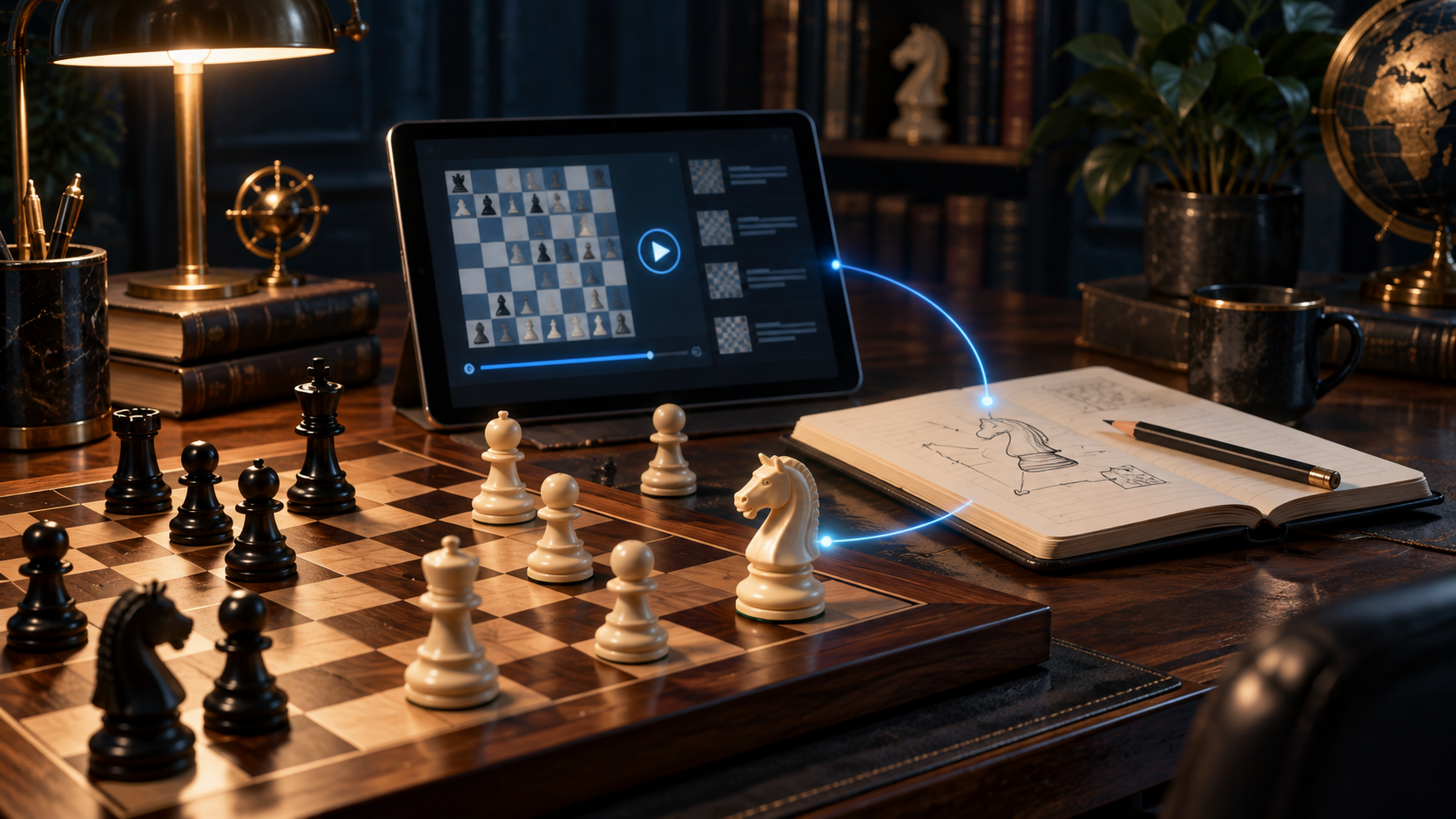
How to Study a Chess Course: 5 Easy Steps
A useful lesson should leave you with something you can do on the board. Learning how to study a chess course starts with one habit: choose your own move before hearing the explanation.
The free Chess Training Program pairs opening videos with notes and endgame lessons with practical play. Here is a simple way to apply that approach to your next lesson.
📍 In this guide
Table of Contents
🎯 1. Choose one question
Give the lesson a clear job. Instead of “get better at strategy,” ask: “Which piece should I improve first?”
Open your board and prepare one relevant position. A lesson from Master Chess Strategy gives you somewhere to practise comparing plans; choose a topic that matches a problem in your games.
Pick a lesson whose starting position you understand. If every explanation assumes unfamiliar knowledge, study that prerequisite first. A harder video is useful when it answers a question you are ready to work on.
🧠 2. Pause and decide
Before the instructor reveals an important move, pause. Check your opponent’s threat, choose two candidate moves, and explain which one you prefer.
Give yourself a minute or two. Keep the engine off for this first attempt: you need your own answer to compare with the lesson.
Ask: “What would my opponent do after my move?” That question often exposes the detail you initially missed.
✍️ 3. Keep one useful note
Compare the reasoning behind the move, then record the difference. You might choose the same move for the wrong reason, or find another reasonable option.
Try this note format:
- My idea: Chase the knight with a pawn.
- What I missed: Its retreat is strong and my advance weakens a square.
- Next time: Check the retreat before pushing.
One precise note is easier to use than a copied paragraph. Add the lesson timestamp so you can find the position again.
📘 4. Use the supporting files
The Weekly Training Program PDF includes endgame practice against a bot. After a lesson from the Complete Endgame Course, set up a suitable position and try carrying out the technique yourself.
If your course includes a PGN, replay one main line before exploring its branches. Need a digital board? The official Lichess Study guide explains working with moves, variations and comments.
Hide the continuation when you revisit the position. Following moves with the answer visible can feel easier than finding them yourself in a game.
✅ 5. Test the idea
Close your notes and return to the key position. Can you explain the plan, choose a move, and identify your opponent’s reply?
If the move is familiar but its purpose is unclear, revisit that moment. Later, use your game analysis to check whether you recognise similar decisions in practice.
⏱️ How to study a chess course in 25 minutes
Try this short session; these timings are an example, separate from the PDF’s weekly schedule.
- 2 minutes: Choose your question and prepare the board.
- 12 minutes: Watch, pause and make decisions.
- 6 minutes: Practise one position.
- 5 minutes: Recall the idea and write your takeaway.
You do not have to finish the video. Stop at a useful point and mark where to continue.
💬 Quick questions
How to study a chess course on your phone?
Keep one position on screen, pause often, and save a short timestamped note. A physical board beside your phone also works.
How to study a chess course without memorising everything?
Understand the main idea first. Learn concrete sequences where needed, then revisit the positions you cannot yet explain.
Tag:Chess Training

You may also like

How To Play Gambit Positions In Chess?

How To Avoid Chess Opening Traps?