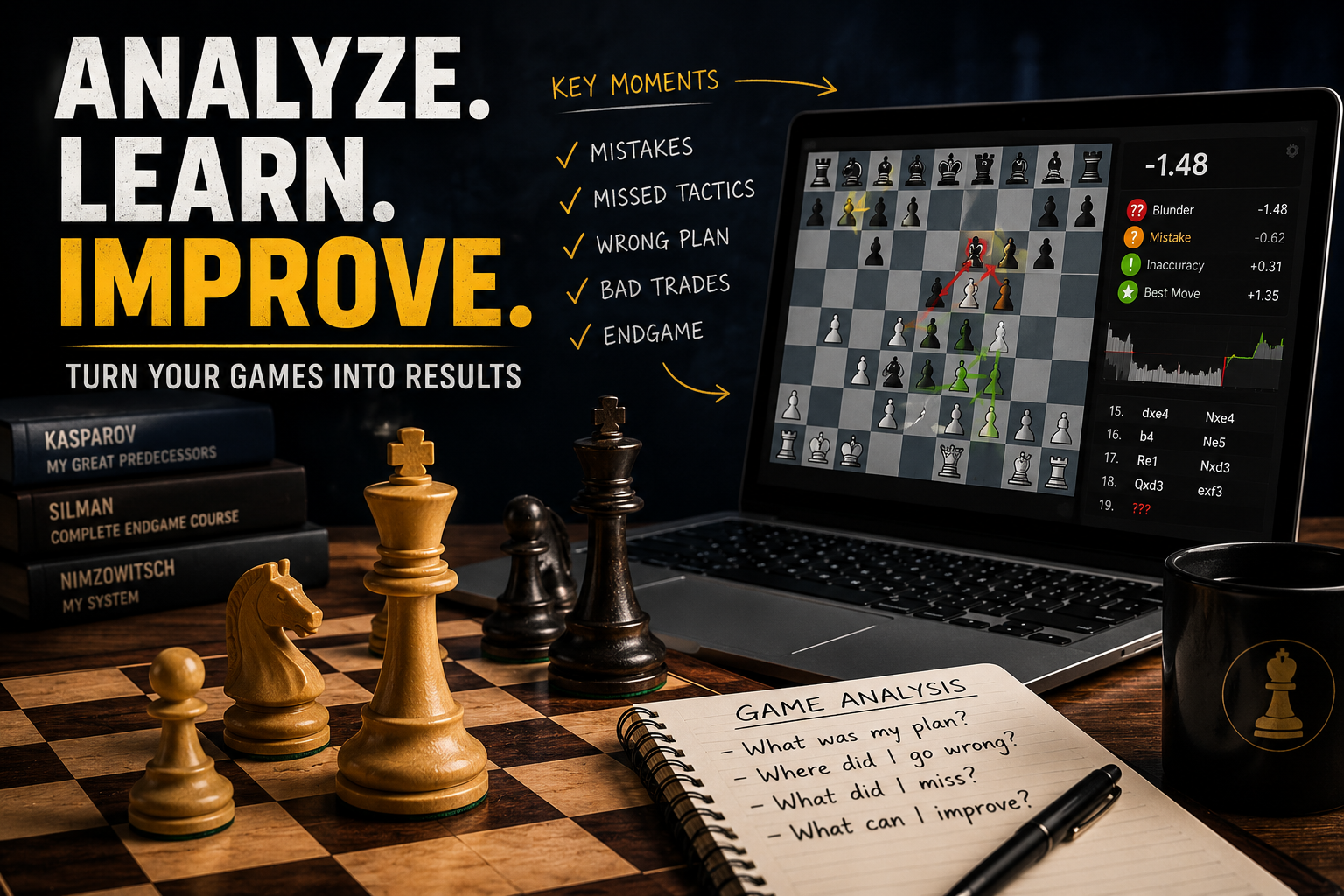
How To Analyze Your Chess Games?
♟️📊 Want to improve faster from your own games?
🔥 Most chess players play many games, but they do not learn enough from them.
😩 They lose, check the engine quickly, see one blunder, and move on.
⚠️ They look only at the opening mistake.
🧠 They do not understand why the position went wrong.
🔄 They repeat the same mistakes next week.
🏆 They play a lot, but their rating barely moves.
If you want to learn how to analyze chess games, you need a clear method.
Game analysis is one of the fastest ways to improve because it shows your real weaknesses — not imaginary weaknesses, not random puzzle mistakes, but the exact problems that happen in your own games.
🧠 1. Analyze Before Using The Engine
This is the most important rule.
Do not start with the engine immediately.
If you turn on the engine too early, you may see the best move, but you will not understand your thinking mistake.
First, analyze the game yourself.
Ask:
🔷 Where did I feel uncomfortable?
🔷 Where did I spend too much time?
🔷 Where did I miss my opponent’s idea?
🔷 Where did the evaluation change?
🔷 Which move would I choose now?
This helps you train your own brain.
The engine should be used later as a checking tool, not as a replacement for thinking.
Strong players analyze their decisions first. Then they compare with the engine.
That is how real improvement happens.
🎯 2. Find The Critical Moments
Not every move deserves the same attention.
Many players waste time checking every small engine difference.
Instead, focus on critical moments.
A critical moment is a point at which one decision changes the direction of the game.
Examples:
⚡ choosing a plan
⚡ deciding whether to trade
⚡ calculating a tactical line
⚡ defending against an attack
⚡ entering an endgame
⚡ choosing whether to sacrifice
⚡ responding to an opponent’s threat
Ask yourself:
“What was the turning point of the game?”
Usually, every game has 2–5 important moments. These are the positions that teach you the most.
Do not only ask, “What was the best move?”
Ask, “Why was my move wrong?”
That question is much more valuable.
🧮 3. Check Your Calculation Mistakes
Many games are lost due to calculation errors.
Sometimes you miss a tactic.
Sometimes you stop calculating too early.
Sometimes you calculate one line but ignore the opponent’s best reply.
Sometimes you see the correct move but evaluate the final position badly.
When analyzing, look for moments where calculation mattered.
Ask:
🔷 Did I check forcing moves?
🔷 Did I consider checks, captures, and threats?
🔷 Did I calculate my opponent’s best reply?
🔷 Did I visualize the final position clearly?
🔷 Did I evaluate the result correctly?
This is exactly why the Calculation & Evaluation Technique is useful. It helps players improve candidate moves, visualization, evaluation, and practical decision-making.
If your analysis shows repeated calculation errors, do not ignore them.
That is a training signal.
♟️ 4. Look At Your Plans, Not Only Blunders
A game can go wrong even without one huge blunder.
Sometimes you slowly drift into a worse position because your plan was wrong.
Maybe you pushed pawns on the wrong side.
Maybe you allowed a strong outpost.
Maybe you traded your good bishop.
Maybe you ignored an open file.
Maybe you did not improve your worst piece.
When analyzing middlegames, ask:
🔷 What was my plan?
🔷 Was it connected to the pawn structure?
🔷 Did I improve my worst piece?
🔷 Did I create weaknesses or only make random moves?
🔷 Did I stop my opponent’s plan?
Many players only care about tactics, but planning mistakes are just as serious.
If you often reach playable positions but then feel lost, Middlegame Planning can help you understand piece improvement, exchanges, pawn structures, and long-term plans.
Good analysis should reveal how you think, not only where the engine disagrees.
🏆 5. Study Your Conversion Mistakes
Many players only analyze losses.
That is a mistake.
You should also analyze games where you were winning but failed to convert.
Ask:
🔷 When did I get the advantage?
🔷 Did I rush?
🔷 Did I allow counterplay?
🔷 Did I trade into the wrong endgame?
🔷 Did I stop calculating because I thought the game was easy?
Conversion mistakes are extremely serious.
Getting a better position is only half of the job.
Winning it is the real skill.
If you often get good positions but fail to finish them, Advantage To Victory is a very natural course to study because it focuses on converting better positions, reducing counterplay, and turning advantages into wins.
When analyzing your games, pay special attention to the moment the advantage started slipping away.
That moment usually teaches a lot.
🏰 6. Review Your Endgames Carefully
Endgames are easy to ignore because they come late in the game.
But many games are decided there.
When analyzing endgames, ask:
🔷 Was my king active enough?
🔷 Did I know which pieces to trade?
🔷 Did I understand the pawn race?
🔷 Was my rook active or passive?
🔷 Did I create a passed pawn?
🔷 Did I allow unnecessary counterplay?
Many endgame mistakes are not obvious without analysis.
You may think the game was drawn, but there was a winning plan.
You may think you were winning, but the position was technically drawn.
You may think one pawn did not matter, but it completely changed the endgame.
If endgames are a repeated weakness, the Complete Endgame Course can help you build a stronger foundation in practical technique, conversion, defense, and important endgame structures.
Endgame analysis improves your patience and precision.
📚 7. Write Down Lessons From Each Game
This is where many players fail.
They analyze a game, but they do not write anything down.
Then they forget the lesson.
After every serious game, write 2–4 key notes.
For example:
✅ I forgot to check my opponent’s threat.
✅ I traded into a bad endgame.
✅ I calculated only my attacking moves.
✅ I needed to improve my worst piece.
✅ I rushed when I was winning.
✅ I did not understand the pawn structure.
Keep these notes simple.
Over time, you will see patterns.
Maybe you always lose because of time pressure.
Maybe you miss tactics when attacking.
Maybe you struggle against closed positions.
Maybe you do not convert endgames.
Maybe you chose the wrong plans in the middlegame.
Your games will tell you exactly what to train.
That is why a structured Chess Training Program can be useful. It helps you organize your improvement instead of randomly jumping between openings, puzzles, and online games.
✅ Simple Game Analysis Checklist
Use this checklist after every serious game:
✅ Analyze without the engine first.
✅ Find 2–5 critical moments.
✅ Check calculation mistakes.
✅ Review your middlegame plans.
✅ Study conversion mistakes.
✅ Review the endgame carefully.
✅ Use the engine only after your own analysis.
✅ Write down the main lessons.
✅ Decide what to train next.
This process does not need to take hours for every game.
Even 20–30 minutes of honest analysis can teach more than playing five random blitz games.
🚀 Final Lesson
Learning how to analyze chess games is one of the best ways to improve.
Your own games show your real weaknesses.
They show how you calculate, plan, defend, convert, and make decisions under pressure.
Do not only ask, “What was the engine move?”
Ask better questions:
♟️ What was I thinking?
🧠 Why did I choose this move?
⚡ What did I miss?
🎯 What was the correct plan?
🏆 What should I train next?
If you analyze your games properly, every loss becomes useful.
Every mistake becomes information.
Every game becomes a training lesson.

You may also like
How to Study a Chess Course: 5 Easy Steps
How To Play Gambit Positions In Chess?