
How To Exploit A Weak Back Rank In Chess?
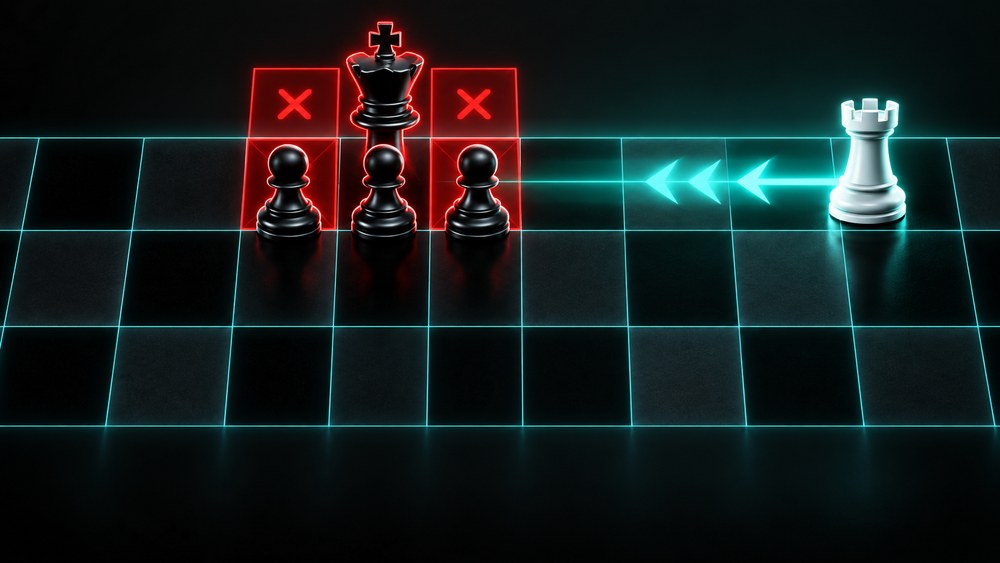
🚪 How To Exploit A Weak Back Rank In Chess starts by noticing a king trapped behind its own pawns. Even when immediate mate is impossible, back-rank pressure can overload defenders and create tactical wins elsewhere.
A trapped king is a signal to calculate, not proof of an immediate mate. To exploit a weak back rank, identify the entry square, the remaining defender and every legal escape. Then look for a move that changes one of those details.
🚪 A weak back rank: look for the missing escape square
A weak back rank exists when the king has no flight square and an enemy rook or queen can invade. The defending major pieces may be forced to guard mate, making them vulnerable to deflection or overload.
You do not always need to deliver mate. Threatening it can win a queen, control an open file, or force a damaging pawn move that weakens the king permanently.
🔍 When Should You Look For It?
- The king has no pawn-created flight square
- An open file reaches the back rank
- Only one rook or queen prevents mate
- A defender is pinned to the back rank
- A forcing exchange can remove the final guard
These signs do not replace calculation, but they tell you when the position deserves extra attention. The more of them that appear together, the more likely the theme is to affect the best move.
🧭 A Step-By-Step Plan
- Check for luft: Identify whether the king can escape after a rook or queen check.
- Control the open file: Double rooks or place the queen behind a rook to increase pressure.
- Deflect the guard: Attack the piece that alone protects the back rank.
- Use tactical threats: Pins, skewers, and overloaded defenders often appear around the mating idea.
- Convert the concession: If the opponent creates luft, target the newly weakened pawn or square.
Work through the steps in order until the process becomes natural. In a practical game, you may complete the scan in seconds because the relevant relationships are already familiar.
♟️ A Practical Example
A rook on e8 may defend both a queen and the back-rank mate. Exchanging on e8 can force that rook away, making the queen loose; alternatively, a queen sacrifice on the back rank may lead to forced mate. The first task is to identify which duty cannot be abandoned.
Notice that the correct decision comes from the position’s demands rather than a slogan. Good chess principles guide your search, while concrete calculation confirms the move.
❌ Common Mistakes
- Assuming every back-rank check is mate
- Trading the attacking rook without calculating the recapture
- Forgetting an interposition square
- Continuing the attack after the defender has created a safe flight square
The most dangerous mistake is using a correct idea in the wrong position. Always compare the strategic plan with immediate tactical details before committing.
🎯 A Training Method That Works
When reviewing games, mark every position where a king lacks luft. Search for rook invasions, deflections, and exchange combinations even if no tactic occurred. This trains you to detect the weakness before the opportunity becomes obvious.
Keep the exercises short enough to repeat consistently. Regular focused sessions create stronger pattern recognition than one long session followed by several weeks without practice.
✅ Quick Checklist
- Check for luft
- Control the open file
- Deflect the guard
- Use tactical threats
- Convert the concession
Use this checklist during training first. With repetition, it becomes a fast internal scan that supports better decisions without consuming too much time.
♟️ Coach’s Practical Test
Choose a position with a boxed-in king and identify the defender that controls the invasion square. Calculate three methods of exploitation: remove that defender, overload it, or divert the enemy rook with a separate threat. Include the opponent’s best luft-making move in every line.
After solving, move one pawn to give the king an escape square and solve again. You will see which combinations truly depend on mate and which still win material through rook penetration or tactical deflection.
♟️ A weak back rank: test the mate and the defender
Set up a simple position with White’s king on g1 and rook on e1. Black has a king on g8 and pawns on f7, g7 and h7. There are no other pieces, and White moves first.
Re8# is mate. The rook checks along the eighth rank, controls f8 and h8, and Black’s own pawns occupy the king’s other neighbouring squares. There is no black piece available to capture the rook or block the check.
Now add a black rook on a8 and try the same move. Re8+ can be met by …Rxe8 because the path from a8 to e8 is clear. The boxed-in king still looks vulnerable, but the extra defender changes the calculation completely.
As another comparison, return to the original position and move Black’s h-pawn from h7 to h6. After Re8+, the king can escape to h7 in this simplified setup. In a real game, check whether another white piece controls that escape square before relying on it.
💬 Weak back rank questions
What should I check before a sacrifice?
Verify the entry square, every possible capture of the attacking piece, every interposition and every king move. Then check the opponent’s alternatives to accepting the sacrifice. A mating idea is only as strong as its answer to the best defence.
Can a back-rank threat win material without mate?
Yes. A defender may be unable to leave its post to protect another target. But first prove that abandoning the back rank really allows mate; otherwise the apparently overloaded piece may be free to move.
Should I make an escape square immediately?
Only when the move is useful and safe. A pawn advance can create new weaknesses or lose a necessary tempo. Sometimes defending the entry square, exchanging an attacking rook or giving a forcing check is the better solution.
How can I practise the pattern?
Start with a simple mating position, then add one defender or one escape square. Explain exactly why the original combination stops working. This trains calculation rather than recognition of a familiar final picture alone.
Connect the theme with overloaded defenders and rook activity on the seventh rank. The back-rank category in Lichess puzzle themes provides additional examples.
Final Thoughts
A weak back rank is both a mating danger and a source of overloaded defenders. Control the file, remove the guard, and use the threat of mate to win something concrete.
🌟 Improvement comes from recognizing the right moment, following a clear process, and reviewing the result honestly. Apply the idea in your own games until it becomes part of your natural thinking.

You may also like

How to Study a Chess Course: 5 Easy Steps

How To Play Gambit Positions In Chess?