
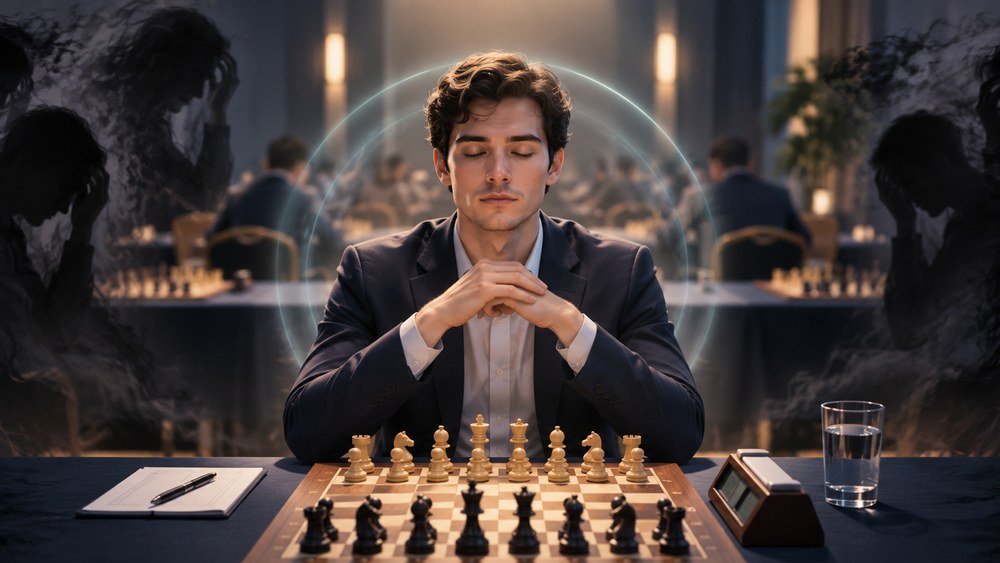
How To Handle Chess Tournament Nerves?
🧘 How To Handle Chess Tournament Nerves starts with accepting that nervous energy is normal. The goal is not to feel nothing; it is to keep a stable routine so emotion does not control your moves or your clock.
Give your attention a task it can actually complete: check the threat, compare a small number of candidate moves, and make a final safety scan. You do not need to feel perfectly calm before making a sensible decision.
🧘 Chess tournament nerves: return to the position
Nerves increase when attention shifts from the position to ratings, results, or imagined consequences. Bring attention back to a physical process: breathe, scan the board, name the opponent’s threat, and select candidates.
Preparation also matters. Sleep, food, arrival time, and a short warm-up reduce uncertainty before the first move.
🔍 When Should You Look For It?
- Your breathing becomes shallow
- You calculate the same line repeatedly
- You avoid strong moves because they feel risky
- You play too quickly to escape tension
- Thoughts focus on rating or result
These signs do not replace calculation, but they tell you when the position deserves extra attention. The more of them that appear together, the more likely the theme is to affect the best move.
🧭 A Step-By-Step Plan
- Use a pre-game routine: Arrive early, organize the board area, and solve a few easy tactical exercises.
- Reset physically: Slow the exhale and relax the shoulders before critical decisions.
- Return to the position: Describe the threat and the changed features after every move.
- Make concrete decisions: Choose candidates from checks, captures, threats, and useful improvements.
- Separate game and result: Judge the quality of your process before judging the score.
Work through the steps in order until the process becomes natural. In a practical game, you may complete the scan in seconds because the relevant relationships are already familiar.
♟️ A Practical Example
After missing a winning chance, a player may rush the next move out of frustration. A thirty-second reset—breathing, rescanning the board, and naming the opponent’s threat—can prevent one mistake from becoming two.
Notice that the correct decision comes from the position’s demands rather than a slogan. Good chess principles guide your search, while concrete calculation confirms the move.
❌ Common Mistakes
- Trying to suppress every nervous feeling
- Changing the entire opening repertoire before an event
- Using the clock to avoid making a difficult decision
- Treating one result as proof of playing strength
The most dangerous mistake is using a correct idea in the wrong position. Always compare the strategic plan with immediate tactical details before committing.
🎯 A Training Method That Works
Simulate tournament conditions in training: use a real clock, sit at a board, remove distractions, and record your thoughts after the game. Practice the same breathing and scan routine until it becomes automatic under pressure.
Keep the exercises short enough to repeat consistently. Regular focused sessions create stronger pattern recognition than one long session followed by several weeks without practice.
✅ Quick Checklist
- Use a pre-game routine
- Reset physically
- Return to the position
- Make concrete decisions
- Separate game and result
Use this checklist during training first. With repetition, it becomes a fast internal scan that supports better decisions without consuming too much time.
♟️ Coach’s Practical Test
Before your next event, rehearse a five-minute routine: slow breathing, review one strategic cue, confirm your practical goal, and visualize making a calm first move. During the game, use the same reset after surprises instead of reacting immediately.
Afterward, record the physical signal that appeared first—racing thoughts, shallow breathing, or rushed movement—and the decision it influenced. The aim is not to eliminate nerves. It is to notice them early enough that your thinking process, clock use, and board awareness remain stable.
♟️ Handling chess tournament nerves after a mistake
Suppose you overlook a tactic and lose a pawn. The temptation is to recover it immediately, even when the position does not justify an attack. Separate the disappointment from the next chess problem: what is the material balance now, which king is less safe, and what is the opponent threatening?
Use a brief reset that fits the clock. Relax your grip, breathe comfortably, and scan the whole board again. Then choose two realistic candidates. If time is short, shorten the routine rather than spending a fixed thirty seconds because a checklist told you to.
Your goal is not to declare the position fine. It is to evaluate the new position honestly and find the most difficult practical task for the opponent. A stubborn defensive move may offer more resistance than a speculative sacrifice played to escape an unpleasant feeling.
After the game, write down the first decision that changed because of your reaction. Did you rush, repeat the same calculation, or avoid a necessary line? Rehearse that specific moment in training. A routine becomes useful when you can apply it to a real decision, not only describe it before the round.
💬 Questions about chess tournament nerves
Should I change my openings before an important event?
A last-minute overhaul can introduce unfamiliar decisions. Prefer reviewing plans, recurring tactics and the main move-order problems in the openings you already play. Make a substantial repertoire change during a training period, with time to test it.
What should I do against a higher-rated opponent?
Use the same board-based process. A rating is not a move. Check the actual threat and calculate the strongest replies instead of assuming every unfamiliar idea must be correct. Equally, do not force an attack just to prove that you are playing boldly.
How should I prepare between rounds?
Check the next round’s practical details, take a break from the previous game, and keep any chess review narrow. One useful correction is easier to carry into the next round than a long list of everything that went wrong.
Connect this routine with better rapid-chess decisions and active defence in difficult positions. For a small chess warm-up, choose familiar material from Lichess practice rather than turning the warm-up into an exhausting test.
Final Thoughts
Tournament nerves become manageable when your attention has a reliable destination. Prepare the body, follow a concrete thinking routine, and evaluate your process independently of the result.
🌟 Improvement comes from recognizing the right moment, following a clear process, and reviewing the result honestly. Apply the idea in your own games until it becomes part of your natural thinking.

You may also like
Basic Checkmates in Chess: 5 Easy Steps to Confident Wins

How To Practice Blindfold Chess?