
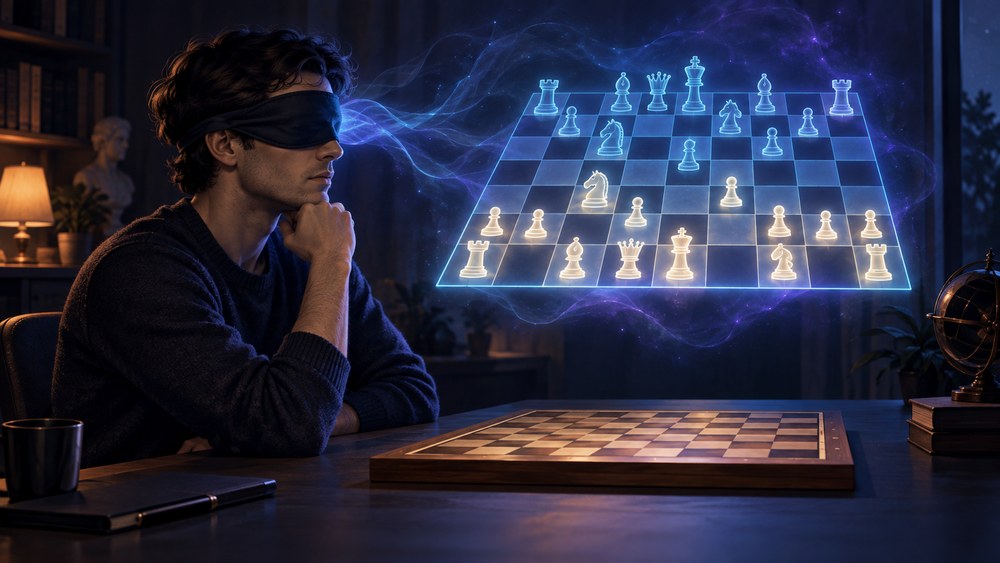
How To Practice Blindfold Chess?
🧠 How To Practice Blindfold Chess should begin with small visualization tasks rather than a full game. Blindfold skill is the ability to maintain an accurate internal board while pieces move and relationships change.
Begin with accuracy, not a full game. A clear picture of six pieces is more useful than a confused picture of thirty-two. The exercises below build from square names to short move sequences, with a simple way to check your progress.
🧠 Blindfold chess: build a reliable mental board
Strong blindfold play combines square knowledge, chunking, and continuous updating. You do not memorize thirty-two independent objects; you remember pawn structures, piece clusters, open lines, and tactical relationships.
Accuracy comes before speed. If the internal board becomes unclear, return to a simpler exercise instead of guessing.
🔍 When Should You Look For It?
- Square colors are not automatic
- Knight routes are difficult to visualize
- Pieces disappear from memory after exchanges
- Long pawn chains are hard to reconstruct
- Calculation errors come from an inaccurate board image
These signs do not replace calculation, but they tell you when the position deserves extra attention. The more of them that appear together, the more likely the theme is to affect the best move.
🧭 A Step-By-Step Plan
- Master coordinates: Name square colors, diagonals, and neighboring squares without looking.
- Visualize short routes: Track a knight, bishop, or rook through a sequence of legal moves.
- Reconstruct positions: Study a simple position, hide it, and rebuild every piece.
- Play reduced-material games: Begin with kings and pawns, then add minor pieces.
- Narrate updates: After every move, state which square was vacated and which was occupied.
Work through the steps in order until the process becomes natural. In a practical game, you may complete the scan in seconds because the relevant relationships are already familiar.
♟️ A Practical Example
Start with kings, four pawns, and one rook per side. Announce moves in notation and pause every five moves to reconstruct the position verbally. Reduced material makes errors easy to detect while training the same updating process used in a full game.
Notice that the correct decision comes from the position’s demands rather than a slogan. Good chess principles guide your search, while concrete calculation confirms the move.
❌ Common Mistakes
- Attempting a full blindfold game immediately
- Guessing after losing the position
- Memorizing a static diagram without updating relationships
- Training while mentally exhausted and reinforcing errors
The most dangerous mistake is using a correct idea in the wrong position. Always compare the strategic plan with immediate tactical details before committing.
🎯 A Training Method That Works
Use fifteen-minute sessions. Spend five minutes on square exercises, five on piece routes, and five on a reduced-material position. End by checking the board and identifying the first point where your image became inaccurate. Record that exact moment in a notebook, then repeat the same sequence until you can hold every square and relationship clearly.
Keep the exercises short enough to repeat consistently. Regular focused sessions create stronger pattern recognition than one long session followed by several weeks without practice.
✅ Quick Checklist
- Master coordinates
- Visualize short routes
- Reconstruct positions
- Play reduced-material games
- Narrate updates
Use this checklist during training first. With repetition, it becomes a fast internal scan that supports better decisions without consuming too much time.
♟️ Coach’s Practical Test
Begin with an empty-board drill: name the color of twenty random squares and trace a knight’s route without looking. Then visualize a position with only two kings, a rook, and three pawns. After four spoken moves, reconstruct it on a board and count the errors.
Increase complexity only after reconstruction is consistently accurate. Blindfold practice is not a memory stunt; it trains stable spatial representation. Short, correct sequences develop calculation more effectively than long sequences that become vague after the first few moves.
♟️ A blindfold chess drill you can check immediately
On an otherwise empty board, place a knight on b1. Hide the board and follow this route: b1–c3–e4–f6–h5. Say the departure and arrival squares at each step. Where is the knight now, and which squares can it attack?
The knight finishes on h5 and attacks f4, f6, g3 and g7. Check the route on a board after answering. This is a piece-movement exercise, not a complete game position: its purpose is to make each update precise.
Repeat the route backwards. Then change one destination and try again. Recalling the memorised answer is not the same as visualising the new route, so vary the exercise once it becomes easy.
Next, set up a legal position containing kings and a few other pieces. Look at it, hide it, and name every occupied square. Only add spoken moves when the starting position is reliable. After a capture, state both what moved and what disappeared; forgotten captured pieces are an easy way to corrupt the picture.
💬 Questions about practising blindfold chess
Do I need a perfectly vivid picture?
No. The practical test is whether you can identify piece locations, legal moves and attacked squares accurately. Use the representation that works for you, and check it against a board rather than judging how visually impressive it feels.
What should I do when I lose track?
Stop at the last position you can reconstruct. Check the first uncertain move, then replay a shorter sequence correctly. Guessing through five more moves makes it harder to find the original error.
How long should a session last?
Start with five to fifteen focused minutes. End with a successful short drill rather than extending a session until every sequence becomes unclear. Keep a small record of the number of pieces, moves followed and reconstruction errors.
Use the Lichess practice positions as visible-board material before attempting recall. Connect this work with calculating pawn races and checking intermediate moves: both require you to update the position accurately.
Final Thoughts
Practice blindfold chess progressively: coordinates, routes, reconstruction, reduced games, then full positions. A precise internal board will also improve ordinary calculation and visualization.
🌟 Improvement comes from recognizing the right moment, following a clear process, and reviewing the result honestly. Apply the idea in your own games until it becomes part of your natural thinking.

You may also like
Basic Checkmates in Chess: 5 Easy Steps to Confident Wins

How To Break Through A Chess Plateau?

2 Comments
Good Article! Thanks!
nice