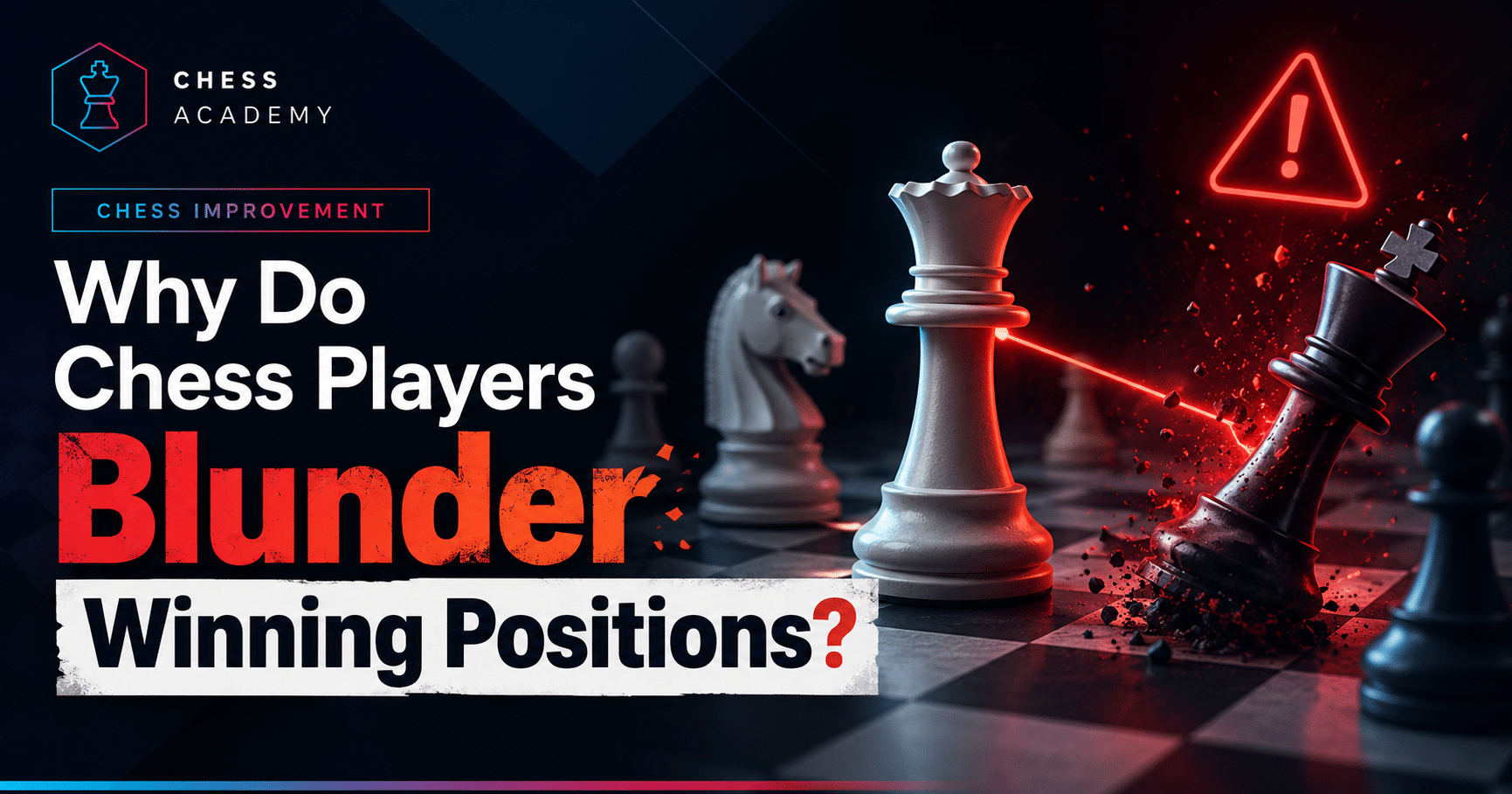
Why Do Chess Players Blunder Winning Positions?
♟️ Every chess player knows the pain.
You play a great game. You win material. You get a better position. Maybe you even reach a completely winning endgame.
Then suddenly — one careless move, one missed tactic, one wrong trade — and the win disappears.
That will look much cleaner.
🧠 Reason 1: You Relax Too Early
Many players think the hard part is getting a winning position.
But in practical chess, the harder part is often converting it.
⚠️ You win material and stop calculating.
😌 You assume the opponent has no counterplay.
♟️ You make “normal moves” instead of accurate moves.
🔥 You forget that the game is not over until checkmate, resignation, or a technically won ending.
Strong players do not relax just because they are better. They become more careful.
A winning position is not a trophy yet. It is only a chance to finish the game.
🔥 Reason 2: You Rush The Conversion
Another reason chess players blunder winning positions is simple: they rush.
They want to finish the game quickly.
This usually leads to bad decisions:
⚡ unnecessary sacrifices
⚡ premature attacks
⚡ careless pawn pushes
⚡ wrong trades
⚡ forcing lines that were not needed
When you are winning, you do not always need to find the most beautiful move. Very often, you need to find the most controlled move.
The goal is not to win immediately.
The goal is to remove counterplay, improve your pieces, and make your advantage bigger step by step.
This is exactly why practical conversion is such an important chess skill. The course Advantage To Victory was created for players who often get better positions but struggle to turn them into wins.
Strong players understand that conversion is a process. They do not give the opponent unnecessary chances. They slowly reduce activity, improve piece placement, and only then look for the final breakthrough.
♟️ Reason 3: You Allow Counterplay
This is a huge reason.
Many players focus only on their own threats when they are winning.
They think:
“I am attacking.”
“I am up material.”
“I have a passed pawn.”
“I should win easily.”
But your opponent is still playing too.
A worse position often creates desperation. Your opponent may look for tricks, sacrifices, perpetual checks, stalemate ideas, or tactical traps.
If you ignore counterplay, your advantage can disappear instantly.
Before every move in a winning position, ask yourself:
🔷 What is my opponent threatening?
🔷 Do they have checks?
🔷 Do they have captures?
🔷 Do they have tactical tricks?
🔷 Can they create a passed pawn?
🔷 Can they force perpetual check?
Strong players are excellent at stopping counterplay.
They do not only ask, “How do I win?”
They also ask, “How can my opponent survive?”
🧩 Reason 4: You Do Not Improve Your Pieces
Many winning positions are not achieved with a single big move.
They are won by improving slowly.
A common mistake is trying to finish the game while one or two of your pieces are still doing nothing.
♟️ Your rook is passive.
♟️ Your king is badly placed.
♟️ Your knight has no clear square.
♟️ Your queen is active, but the rest of the pieces are sleeping.
Before forcing the win, strong players usually improve their worst piece.
This is where practical planning becomes very important. If you often reach good positions but do not know what to do next, studying Middlegame Planning can help you understand piece improvement, coordination, exchanges, and long-term plans.
When all your pieces are active, conversion becomes much easier.
🏆 Reason 5: You Trade Into The Wrong Endgame
Many players hear the rule:
“When you are up material, trade pieces.”
This rule is often useful, but it is not always correct.
Bad trades can turn a winning position into a difficult one.
For example:
♟️ You trade into opposite-colored bishops, which reduces your chances of winning.
♟️ You exchange active pieces and leave yourself with passive ones.
♟️ You trade queens but enter a rook endgame with counterplay.
♟️ You simplify into a pawn endgame that is actually drawn.
This is why endgame understanding is so important.
If you do not understand endgames, you may choose the wrong simplification. You may think you are making the position easier, but actually, you are giving your opponent drawing chances.
A strong endgame foundation helps you know which trades are good and which trades should be avoided.
Players who want to improve this part of their game can study the Complete Endgame Course, which focuses on practical endgame technique, conversion, defense, and real decision-making.
You can also explore all Chess Endgame Courses if you want to improve pawn endgames, rook endgames, minor piece endgames, queen endgames, and practical conversion.
🧮 Reason 6: You Stop Calculating Carefully
A very common mistake is thinking that calculation is only needed in sharp positions.
But winning positions also require calculation.
Sometimes the most dangerous moment is when the position looks simple.
You may think:
“This is easy.”
“I can play anything.”
“My opponent has no moves.”
Then suddenly there is a tactic.
Strong players continue to calculate even in winning positions. They check forcing moves, tactics, and defensive resources before making decisions.
A good habit is to always check:
⚡ opponent checks
⚡ opponent captures
⚡ opponent threats
⚡ tactical sacrifices
⚡ back rank ideas
⚡ loose pieces
⚡ king safety
This simple habit prevents many painful blunders.
If you often miss tactics during conversion, Calculation & Evaluation Technique can help you improve your candidate moves, visualization, evaluation, and practical decision-making.
🧠 How To Stop Blundering Winning Positions
The solution is not just “be careful.”
That is too general.
You need a clear, practical method.
When you are winning, follow this process:
🔷 First, identify your advantage.
Are you up material, better structurally, a safer king, better pieces, or do you have a passed pawn?
🔷 Second, stop counterplay.
Do not allow unnecessary tactics, checks, or active pieces.
🔷 Third, improve your worst piece.
Winning positions often become easy when all your pieces are active.
🔷 Fourth, trade only when it helps.
Do not exchange pieces automatically. Make sure the simplified position is actually winning.
🔷 Fifth, calculate before every important move.
Even if the position looks easy, check your opponent’s forcing replies.
This approach makes your conversion much more stable.
🎯 Winning Positions Require Technique
Many chess games are not decided by who gets a better position first.
They are decided by who converts better.
That is why strong players spend so much time improving technique.
They know how to:
♟️ reduce counterplay
♟️ improve pieces slowly
♟️ choose the correct trades
♟️ calculate critical moments
♟️ convert endgames
♟️ Stay calm under pressure
Preparation for opening is important, but technique decides many practical games.
Getting a winning position is only step one.
Converting it is what gives you the full point.
🚀 Final Lesson
Chess players blunder winning positions because they relax too early, rush the win, ignore counterplay, fail to improve pieces, trade incorrectly, and stop calculating carefully.
The good news is that all of these problems can be fixed.
With better endgame technique, stronger calculation, and a practical conversion method, you can start turning winning positions into actual victories.
♟️ Play calmly.
🧠 Think clearly.
🔥 Stop counterplay.
🏆 Convert like a strong player.

You may also like

How to Study a Chess Course: 5 Easy Steps
How To Play Gambit Positions In Chess?