
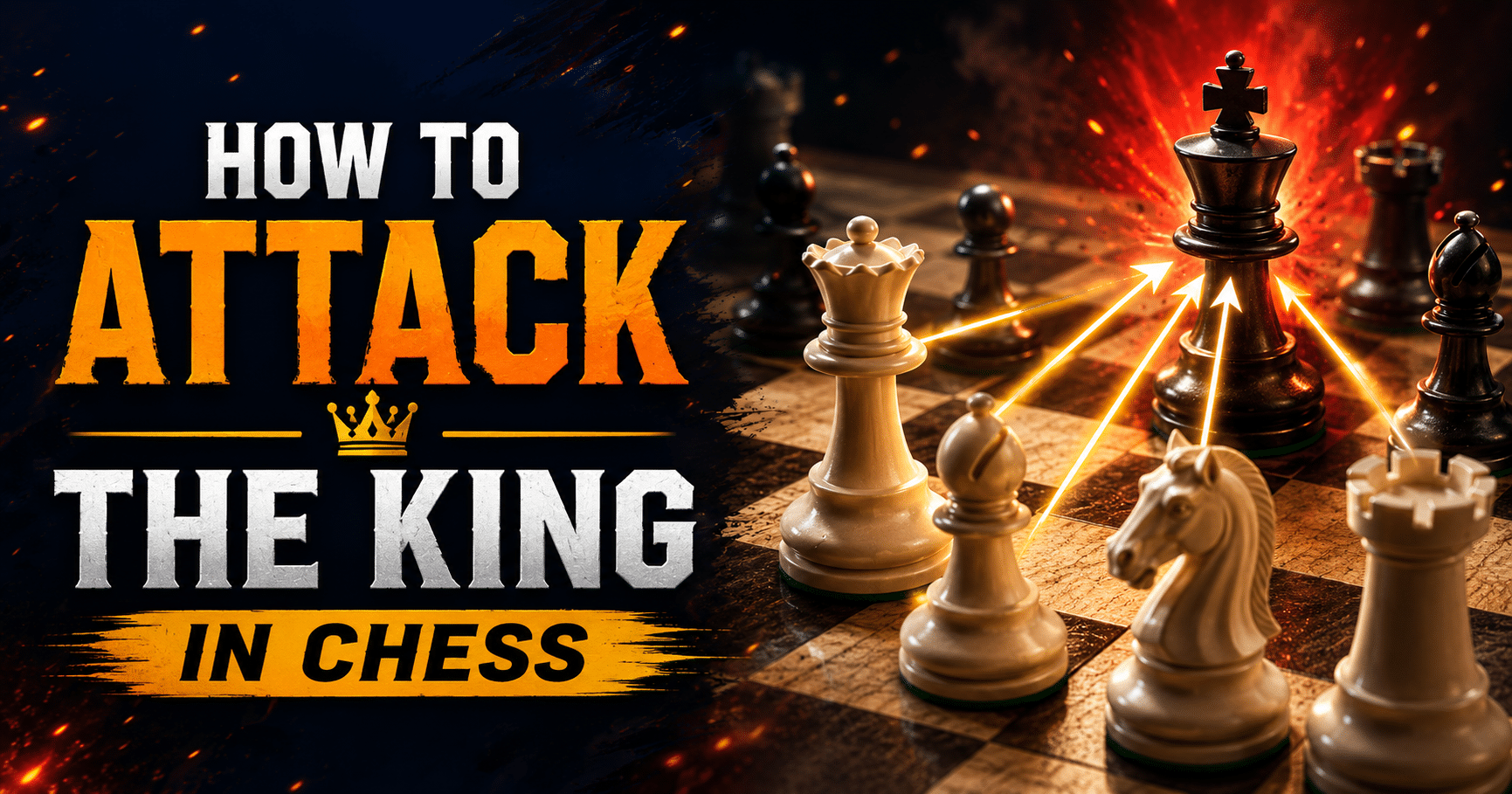
How to Attack the King in Chess: 7 Powerful Principles
♟️ Learning how to attack the king in chess starts with a position check, not a pawn push. Before you sacrifice, compare king safety, attackers and defenders, open lines, and the opponent’s counterplay.
A sound attack is usually built by bringing more pieces toward the king, opening a file or diagonal, removing an important defender, and calculating the opponent’s best forcing reply.
Table of Contents
Table of Contents
If those ingredients are missing, improve your position first. Use the seven principles below as a practical checklist before committing to an attack.
🔥 1. Bring More Pieces Into The Attack
One of the biggest mistakes in attacking chess is attacking with too few pieces.
Many players start with one queen check, one knight jump, or one bishop sacrifice and hope it works.
But a real attack usually needs several pieces working together.
Before attacking, ask:
🔷 How many pieces are near the enemy king?
🔷 Is my queen ready to join?
🔷 Are my rooks connected to open files?
🔷 Are my bishops pointing toward the king?
🔷 Do my knights have attacking squares?
If only one piece is attacking, your opponent can usually defend.
If three or four pieces are attacking, the position becomes dangerous.
This is one of the most important attacking principles taught in Attacking Mastery, because strong attacks are built through coordination, not hope.
♟️ 2. Open Lines Toward The King
To attack the king, you need access.
If the position is completely closed, your pieces may look active but have no way to reach the enemy king.
That is why open lines are so important.
You should look for:
⚡ open files
🔥 open diagonals
♟️ pawn breaks
🎯 weak squares around the king
🧠 ways to remove defenders
For example, if your rook is on the same file as the opponent’s king, opening that file can become a major attacking idea.
If your bishop points toward h7, g6, or b1-h7 diagonals, sacrifices may become possible.
If your queen and bishop attack the same square, tactical ideas can appear quickly.
Attacking chess often starts with this question:
“Which line do I need to open?”
🧠 3. Understand King Safety
You cannot attack the king well if you do not understand the king’s safety.
A king is usually vulnerable when:
⚠️ The pawn shield is weakened
⚠️ Important defenders are missing
⚠️ The center is open
⚠️ The king has no escape squares
⚠️ pieces are far away from defense
Sometimes the opponent’s king looks safe, but one small weakness changes everything.
For example:
♟️ a pawn on g6 can create dark-square weaknesses
♟️ a pawn on h6 can give sacrifice ideas
♟️ A missing knight defender can weaken f7 or h7
♟️ An open file can allow rook invasion
♟️ A weak back rank can decide the game
Strong players attack weaknesses, not just the king.
They look at the squares around the king and ask:
“Which squares can I use?”
⚡ 4. Use Forcing Moves
When attacking, forcing moves are extremely important.
The main forcing moves are:
⚡ Checks
⚔️ Captures
🔥 Threats
These moves reduce your opponent’s options and make calculation easier.
Before choosing an attacking move, always check:
🔷 Do I have a strong check?
🔷 Can I capture a defender?
🔷 Can I create a direct mate threat?
🔷 Can I force the king into danger?
🔷 Can I win material after the attack?
Many strong attacks are based on forcing sequences.
You do not need to calculate every quiet move in the position. First, calculate the forcing ones.
But be careful: not every check is good.
Bad checks can help the opponent improve their king’s position.
This is why attacking chess must be connected with calculation. If you want to improve your accuracy in sharp positions, the Calculation & Evaluation Technique can help you train candidate moves, visualization, forcing lines, and final-position evaluation.
🎯 5. Remove The Defenders
A king is usually protected by pieces.
If you remove those defenders, the attack becomes much stronger.
Common defensive pieces include:
🛡️ knights near the king
🛡️ bishops guarding key diagonals
🛡️ rooks protecting the back rank
🛡️ queens defending important squares
🛡️ pawns controlling entry points
When attacking, ask:
🔷 Which piece is defending the king?
🔷 Can I trade it?
🔷 Can I sacrifice to remove it?
🔷 Can I deflect it from defense?
🔷 Can I overload it with multiple threats?
Many famous attacks are not random sacrifices.
They are based on removing the defender.
For example, sacrificing a bishop on h7 or h6 only works when the defending pieces cannot return in time.
A good attacker understands both sides: the attacking forces and the defensive resources.
That is why studying The Art Of Defense is also useful — when you understand how defenders survive, you attack them more accurately.
🔥 6. Do Not Attack Too Early
This is a very common mistake.
Many players see the opponent’s castle and immediately start pushing pawns.
But if your pieces are not developed, the attack can fail.
Before launching an attack, check:
♟️ Is my king safe?
♟️ Are my pieces developed?
♟️ Do I control the center?
♟️ Do I have enough attackers?
♟️ Can my opponent counterattack?
If the answer is no, you may need to prepare first.
Sometimes the best attacking move is not a sacrifice.
Sometimes it is:
🔷 improving your worst piece
🔷 bringing a rook to an open file
🔷 moving the queen closer
🔷 controlling a key square
🔷 stopping counterplay
This is where planning matters.
A strong attack often results from good preparation. If you struggle to find the right moment to attack, Middlegame Planning can help you understand piece improvement, coordination, timing, and long-term attacking ideas.
🏆 7. Keep The Initiative
In attacking chess, initiative means making threats and forcing your opponent to respond.
This is very powerful.
When you have the initiative, your opponent has less time to create counterplay.
But initiative can disappear quickly if you slow down at the wrong moment.
To keep the initiative, ask:
⚡ Can I make a forcing move?
🔥 Can I create a new threat?
♟️ Can I bring another piece into the attack?
🎯 Can I attack a defender?
🧠 Can I improve my position while keeping pressure?
Strong attacking players know when to continue and when to stop.
If the attack is working, they keep pressure.
If the attack has no clear continuation, they do not panic. They improve their position and keep control.
🧩 Signs an Attack Deserves Calculation
Before sacrificing or committing pawns, look for concrete reasons to calculate an attack:
🔥 weak squares or an exposed pawn shield around the king
⚡ several pieces already able to join quickly
♟️ a favorable local balance of attackers and defenders
🎯 a file or diagonal you can realistically open
🛡️ a key defender that can be exchanged, deflected, or overloaded
🧠 control of the center, or at least enough stability to prevent a central counterattack
🏆 a king-safety advantage that gives you time to continue
When studying how to attack the king in chess, treat these as prompts for calculation, not proof that a sacrifice works. Once you identify the attacking features, test your candidate moves against the opponent’s strongest defensive reply before committing.
🚫 Common Attacking Mistakes
Many attacks fail because of basic mistakes.
Avoid these:
⚠️ sacrificing without calculation
⚠️ attacking with only the queen
⚠️ ignoring the opponent’s counterplay
⚠️ pushing pawns before development
⚠️ trading your attacking pieces
⚠️ missing defensive resources
⚠️ forcing the attack when preparation is needed
Learning how to attack the king in chess is exciting, but it must be disciplined.
The best attackers understand how to attack the king in chess without becoming reckless.
They are accurate.
🧠 A 20-Minute King-Attack Training Routine
To practise how to attack the king in chess, choose one middlegame position with genuine attacking chances and give yourself a short, repeatable session:
5 minutes — diagnose: mark the weak squares around the king, count attackers and defenders, and identify the line you would most like to open.
7 minutes — calculate: choose two or three candidate moves. Start with checks, captures, and direct threats, but reject forcing moves that improve the opponent’s king or lose control of the position.
5 minutes — defend for the opponent: find the strongest defensive reply, including exchanges, counterattacks in the center, and ways to return extra defenders.
3 minutes — review: compare your calculation with the game or engine, then write one sentence explaining why your best attacking move works—or why the attack should be postponed.
When the position comes from one of your own games, use your game analysis to record the missed attacking cue and the defensive resource you overlooked.
How to Attack the King in Chess: FAQs
When should I start a king attack?
Start when your pieces can join quickly, useful lines can be opened, and the opponent cannot answer with a stronger central or queenside threat. Learning how to attack the king in chess means recognizing when preparation is more valuable than an immediate sacrifice.
Do I need to sacrifice material?
No. Many strong attacks win by improving piece placement, restricting defenders, and creating several threats. A sacrifice is justified only when calculation shows enough compensation or a forced result.
Which moves should I calculate first?
Begin with checks, captures, and direct threats, then test the opponent’s best defense. Use a board or a private Lichess Study to replay attacking positions and record the defensive resources you missed.
How can I practise attacking without becoming reckless?
Practise how to attack the king in chess with the 20-minute routine above: diagnose the position, calculate candidates, defend for the opponent, and review the result. This keeps attacking play connected to sound decision-making.
🚀 Final Lesson
Learning how to attack the king in chess is one of the most exciting parts of improvement.
But a good attack is not just emotion.
It needs:
♟️ piece coordination
🔥 open lines
⚡ forcing moves
🎯 weak-square control
🛡️ removal of defenders
🧠 accurate calculation
🏆 good timing
Do not attack just because you want to.
Attack because the position is ready.
📚 For more structured training, you can also explore our Middlegame Courses at Modern Chess Academy.
♟️ When your pieces are coordinated and the opponent’s king is weak, attacking chess becomes powerful, practical, and beautiful.

You may also like

How to Study a Chess Course: 5 Easy Steps

Gambit Positions in Chess: 5 Keys to Strong Compensation