How To Improve Calculation In Chess?
♟️ Many players ask how to improve calculation in chess, but the answer is not just “solve more puzzles.”
Tactics are important, of course. But real chess calculation is much deeper than finding a one-move trick.
In a real game, you must choose candidate moves, calculate forcing lines, visualize future positions, evaluate the result, and make a practical decision under time pressure.
That is why many players miss tactics even when they study puzzles.
They see tactical patterns in training, but during a real game:
⚠️ They calculate random moves.
🔄 They jump between variations.
😩 They forget the position in their head.
♟️ They stop too early.
🧠 They calculate deeply but evaluate badly.
Good calculation is not magic. It is a trainable skill.
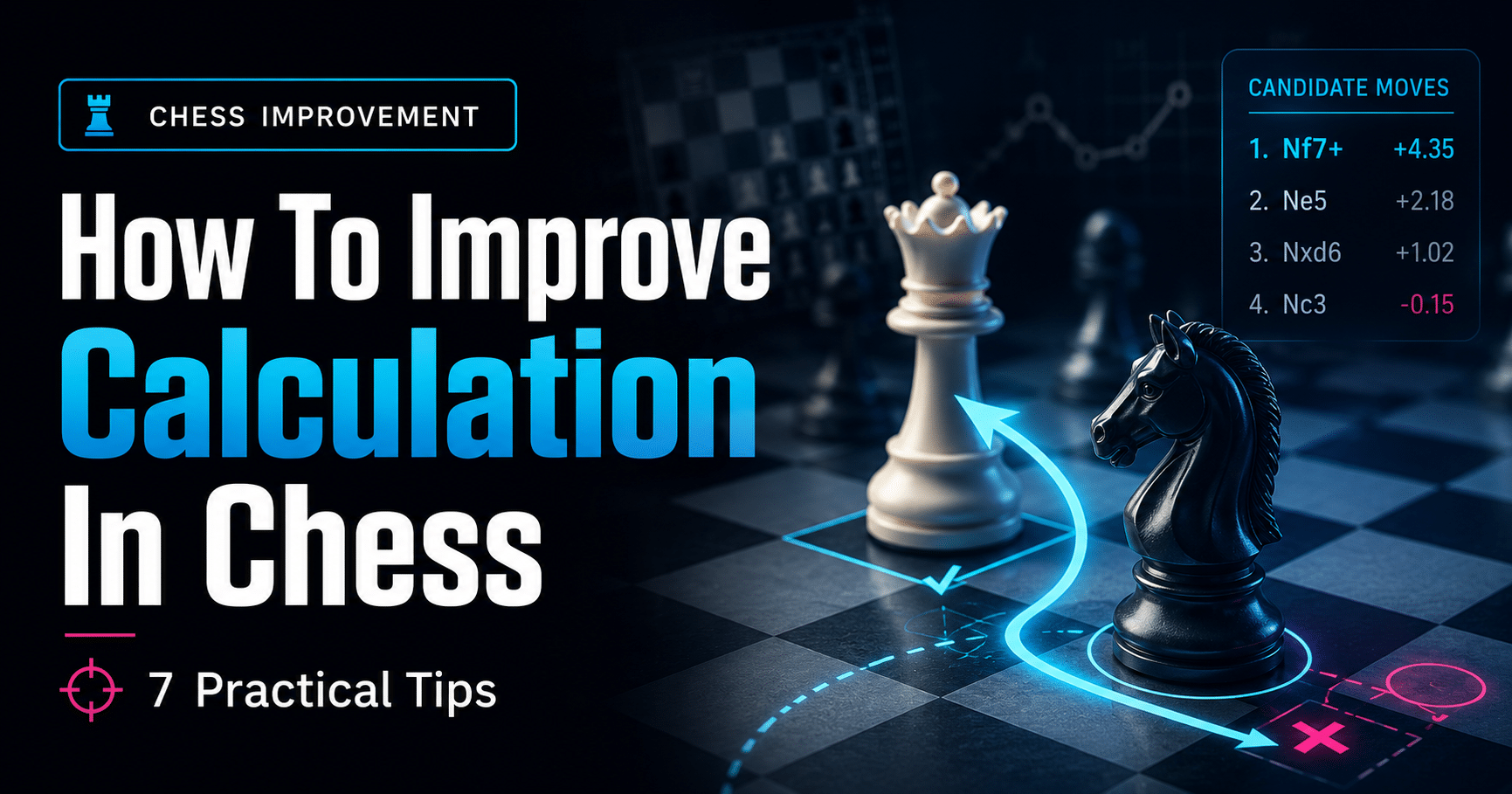
🧠 1. Start With Candidate Moves
One of the biggest mistakes in chess calculation is calculating the first move that comes to mind.
You see a check, a capture, or an attacking move — and immediately start calculating it.
But strong players usually begin with candidate moves.
Before calculating deeply, ask:
🔷 What are my forcing moves?
🔷 What are my opponent’s threats?
🔷 Which moves improve my position?
🔷 Which moves create problems for my opponent?
🔷 Which moves are tactically possible?
This gives your thinking structure.
Instead of calculating randomly, you first collect reasonable options. Then you compare them.
This is one of the most important skills taught in Calculation & Evaluation Technique, because better calculation starts with better move selection.
⚡ 2. Calculate Forcing Moves First
Forcing moves are the easiest moves to calculate because your opponent has fewer choices.
The main forcing moves are:
⚡ Checks
⚔️ Captures
🔥 Direct threats
When you are looking at a position, always check forcing moves first.
Not because they are always best, but because they can quickly reveal tactics.
Many combinations are missed because players focus only on “normal” moves.
Before making a quiet move, ask yourself:
🔷 Do I have a check?
🔷 Do I have a capture?
🔷 Do I have a serious threat?
🔷 Does my opponent have a forcing reply?
This habit alone can save many points.
👁️ 3. Improve Your Visualization
Calculation is not only about seeing moves.
It is about clearly seeing the future position.
Many players calculate three or four moves ahead, but then forget where the pieces are.
That creates blunders.
For example:
♟️ You forget a bishop is defending a square.
♟️ You imagine a knight still on its old square.
♟️ You miss that a rook becomes active after a capture.
♟️ You forget your king becomes weak after the line.
To improve visualization, train yourself to pause after each calculated line and ask:
“Can I clearly see the final position?”
Do not only count moves. Picture the board.
Strong calculation requires a clear mental board.
🎯 4. Evaluate The Final Position
This is where many players go wrong.
They calculate a long line, but they do not correctly judge the final position.
A line can look impressive, but the final position may be bad.
After calculating, ask:
🔷 Who has the safer king?
🔷 Who has better pieces?
🔷 Is the material balance favorable?
🔷 Are there weaknesses?
🔷 Is there counterplay?
🔷 Is the endgame good or bad?
Calculation and evaluation must work together.
This is why pure tactics are not enough. You also need positional understanding.
For example, after a forcing line, you may win a pawn but give your opponent active pieces. Or you may trade queens and end up in a worse endgame.
Good players do not only ask, “Can I do this?”
They ask, “Should I do this?”
🔥 5. Calculate During Attacks With Discipline
Attacking positions are exciting but dangerous.
Many players see a king attack and immediately sacrifice.
Sometimes it works. Sometimes it is just hope.
In attacking positions, calculate carefully:
🔥 Do I have enough pieces near the king?
⚡ Are there forcing moves?
♟️ Can my opponent defend easily?
🛡️ What happens if the attack fails?
🎯 Is there a quiet move that makes the attack stronger?
Attacking chess requires energy and discipline.
If you want to improve this part of your game, Attacking Mastery is a natural course to study because it teaches practical attacking ideas, sacrifices, initiative, and king safety.
🛡️ 6. Calculate Your Opponent’s Resources
Good calculation is not only about your moves.
You must calculate your opponent’s best defense.
This is especially important when you are better or attacking.
Many players calculate like this:
“My move, their bad move, my winning move.”
Strong players calculate like this:
“My move, their best defense, then what?”
That difference is huge.
Before choosing a move, ask:
🔷 What is my opponent’s strongest reply?
🔷 Do they have checks?
🔷 Do they have captures?
🔷 Do they have a defensive resource?
🔷 Can they create counterplay?
This is also why defensive calculation matters. In worse positions, finding one accurate resource can save the game.
A course like The Art of Defense helps players understand defensive resources, counterplay, simplification, and practical survival skills.
♟️ 7. Connect Calculation With Planning
Calculation is not separate from planning.
Sometimes there is no immediate tactic. You must improve your position first.
That means you need to calculate short lines and combine them with long-term ideas.
For example:
♟️ Can I improve my worst piece?
♟️ Can I prepare a pawn break?
♟️ Can I force a better trade?
♟️ Can I create a weakness?
♟️ Can I stop my opponent’s plan?
This is where calculation and strategy meet.
If you often find yourself in positions where nothing tactical is happening and you do not know what to calculate, Middlegame Planning can help you connect calculation with practical plans, piece improvement, exchanges, and positional decisions.
🧩 Practical Training Routine
To improve calculation, you need a consistent training method.
Here is a simple routine:
🔷 Choose a position from a real game.
🔷 Spend 5–10 minutes calculating without moving pieces.
🔷 Write down candidate moves.
🔷 Calculate forcing lines first.
🔷 Evaluate the final positions.
🔷 Compare your analysis with the solution or engine after thinking.
🔷 Review what you missed.
The key is not only solving the position.
The key is understanding why you missed something.
Did you miss a candidate move?
Did you stop calculating too early?
Did you forget a piece?
Did you evaluate the final position badly?
Did you ignore your opponent’s best defense?
That is how real improvement happens.
🏆 Final Lesson
Learning how to improve calculation in chess is one of the fastest ways to become a stronger player.
Better calculation helps you:
⚡ Spot tactics faster.
🧠 Avoid blunders.
🎯 Choose better candidate moves.
🔥 Attack more accurately.
🛡️ Defend difficult positions.
♟️ Convert advantages with confidence.
But remember: calculation is not just about seeing many moves ahead.
It is about thinking clearly.
Start with candidate moves.
Calculate forcing lines.
Visualize the final position.
Evaluate correctly.
Respect your opponent’s resources.
📚 For more structured training, you can also explore our Middlegame Courses at Modern Chess Academy.
♟️ Strong calculation makes every part of your chess better.

You may also like
How to Study a Chess Course: 5 Easy Steps
How To Play Gambit Positions In Chess?