
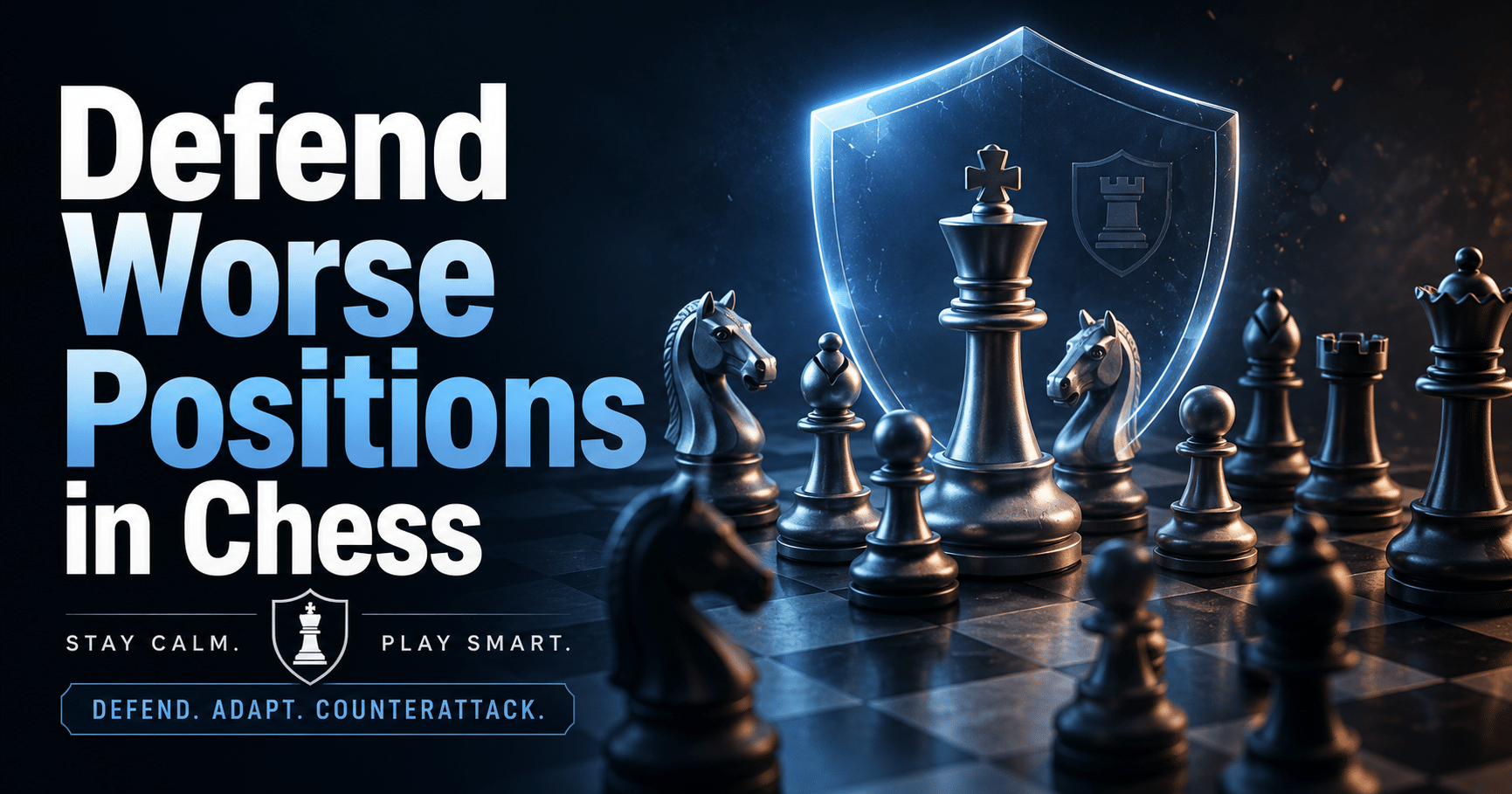
How To Defend Worse Positions In Chess?
🛡️♟️ Worse positions are not lost positions.
🔥 Many chess players panic when something goes wrong. They lose a pawn, get a passive position, face an attack, or enter an uncomfortable endgame — and then collapse quickly.
😩 But strong players are different.
They know how to defend, create counterplay, stay calm, and make the opponent prove the win.
🎯 If you want to learn how to defend worse positions in chess, you need more than patience. You need a practical defensive method.
Many games are saved not because the defender had a perfect position, but because they kept asking good questions and made the opponent’s task difficult.
🛡️ 1. Stay Calm And Do Not Collapse
The first rule of defense is simple:
Do not panic.
Many players lose worse positions because they emotionally give up before the game is actually lost.
They think:
“I am worse.”
“I made a mistake.”
“My opponent should win.”
“There is no point fighting.”
This mindset is dangerous.
In practical chess, many worse positions can still be defended.
Your opponent may:
⚠️ rush the win
⚠️ allow counterplay
⚠️ Choose the wrong Trade
⚠️ miss a tactic
⚠️ fail to convert the advantage
Your job is to stay in the game.
Do not make desperate moves. Do not sacrifice randomly. Do not trade everything without checking the result.
Take a breath, look at the position, and ask:
🔷 What is my opponent threatening?
🔷 What is my biggest problem?
🔷 Can I create counterplay?
🔷 Can I simplify into a better defensive position?
🔷 Can I activate my worst piece?
Defense starts with calm thinking.
⚡ 2. Look For Counterplay
Passive defense is usually painful.
If you only sit and wait, your opponent can improve slowly and finish the game.
That is why counterplay is one of the most important defensive weapons.
Counterplay means creating your own threats, even when you are worse.
It can be:
⚡ attacking the opponent’s king
♟️ creating a passed pawn
🎯 targeting a weakness
🔥 opening a file
🔄 forcing exchanges
🧠 creating tactical problems
Even a small counterplay can make the opponent’s task harder.
Instead of only asking, “How do I survive?” ask:
“How can I make my opponent uncomfortable?”
This is one of the key ideas in The Art of Defense, because strong defense is not only about blocking threats. It is also about creating practical problems for the opponent.
♟️ 3. Activate Your Pieces
A worse position becomes much harder to defend when your pieces are passive.
If your rook is stuck, your knight has no squares, your bishop is blocked, or your queen is only defending, you will suffer.
So one of your main goals is piece activity.
Ask yourself:
🔷 Which piece is doing the least?
🔷 Can I improve my worst piece?
🔷 Can I move my rook to an open file?
🔷 Can my knight find a better square?
🔷 Can my bishop become active on a diagonal?
Sometimes, one active move can change the entire defensive situation.
A passive position with passive pieces is miserable.
A worse position with active pieces may still offer chances.
This is where planning matters. If you often do not know how to improve your pieces, Middlegame Planning can help you understand piece coordination, exchanges, weaknesses, and practical plans.
🔄 4. Simplify Only When It Helps
Many players think that when they are worse, they should trade pieces.
Sometimes this is correct.
But sometimes trading makes the opponent’s job easier.
For example:
♟️ If your opponent has a strong attack, trading queens may help you.
♟️ If your opponent has more space, exchanging pieces may reduce pressure.
♟️ If you are down material, trading too much may leave you in a lost endgame.
♟️ If your active piece is your only source of counterplay, trading it may be a mistake.
So do not trade automatically.
Before every exchange, ask:
🔷 Does this Trade reduce danger?
🔷 Does this Trade remove my opponent’s best piece?
🔷 Does this Trade kill my counterplay?
🔷 Does the endgame become easier or harder for me?
Good defenders know which pieces to exchange and which pieces to keep.
🧠 5. Calculate Your Opponent’s Forcing Moves
When defending, you must be very alert to forcing moves.
Your opponent will often look for:
⚡ checks
⚔️ captures
🔥 direct threats
♟️ sacrifices
🎯 tactical breakthroughs
Before making your move, always check your opponent’s strongest replies.
Do not calculate only the move you want them to play.
Calculate the move you do not want them to play.
Ask:
🔷 What is their strongest check?
🔷 What is their most dangerous capture?
🔷 Can they sacrifice?
🔷 Can they open lines near my king?
🔷 Can they force a winning endgame?
This is why the Calculation & Evaluation Technique is useful even for defense. Better calculation helps you find hidden resources, avoid tactical collapse, and choose practical defensive moves.
Strong defense requires accurate calculation.
🏰 6. Build A Fortress Or Set A Trap
Some worse positions cannot be equalized immediately.
In those cases, your goal may be to build a fortress or create practical traps.
A fortress means your opponent has extra material or a better position, but no clear way to make progress.
Fortress ideas often appear in:
♟️ rook endgames
♟️ opposite-colored bishop endgames
♟️ queen vs rook positions
♟️ blocked pawn structures
♟️ positions with no entry squares
To build a fortress, you usually need:
🛡️ active king
🛡️ compact structure
🛡️ no weaknesses
🛡️ pieces defending key squares
🛡️ patience
Endgame understanding helps a lot here.
If you struggle to defend or convert endgames, the Complete Endgame Course can help you improve practical endgame technique, defensive ideas, and real decision-making.
Sometimes the best defense is not to “win back” the material immediately.
Sometimes the best defense is to make progress impossible.
🎯 7. Make Your Opponent Prove The Win
This is one of the biggest differences between amateurs and strong players.
Amateurs often lose worse positions quickly.
Strong players make the opponent work.
They defend stubbornly.
They create small problems.
They avoid easy simplifications.
They keep pieces active.
They ask practical questions with every move.
Even if your position is objectively bad, your opponent still needs to prove it.
Do not help them.
Make them calculate.
Make them choose.
Make them manage the clock.
Make them find the correct plan.
Make them convert under pressure.
Many games are saved because the defender refused to collapse.
✅ Defensive Checklist
When you are worse, use this checklist:
✅ Stay calm.
✅ Identify the opponent’s main threat.
✅ Look for counterplay.
✅ Improve your worst piece.
✅ Trade only when it helps.
✅ Calculate forcing moves.
✅ Keep your king safe.
✅ Look for fortress ideas.
✅ Make your opponent prove the win.
This simple method can save many difficult games.
🏆 Final Lesson
Learning how to defend worse positions in chess is one of the most important practical skills.
You will not always get good positions.
Sometimes your opening goes wrong.
Sometimes you miss a tactic.
Sometimes your opponent outplays you.
Sometimes you enter a worse endgame.
But ‘worse’ does not always mean ‘lost’.
Strong defenders stay calm, activate pieces, create counterplay, calculate carefully, and make the opponent work until the very end.
📚 For more structured training, you can also explore our Middlegame Courses at Modern Chess Academy.
🛡️ Stay calm.
⚡ Create counterplay.
♟️ Improve your pieces.
🧠 Calculate carefully.
🏆 Fight until the last move.

You may also like
How to Study a Chess Course: 5 Easy Steps
How To Play Gambit Positions In Chess?