
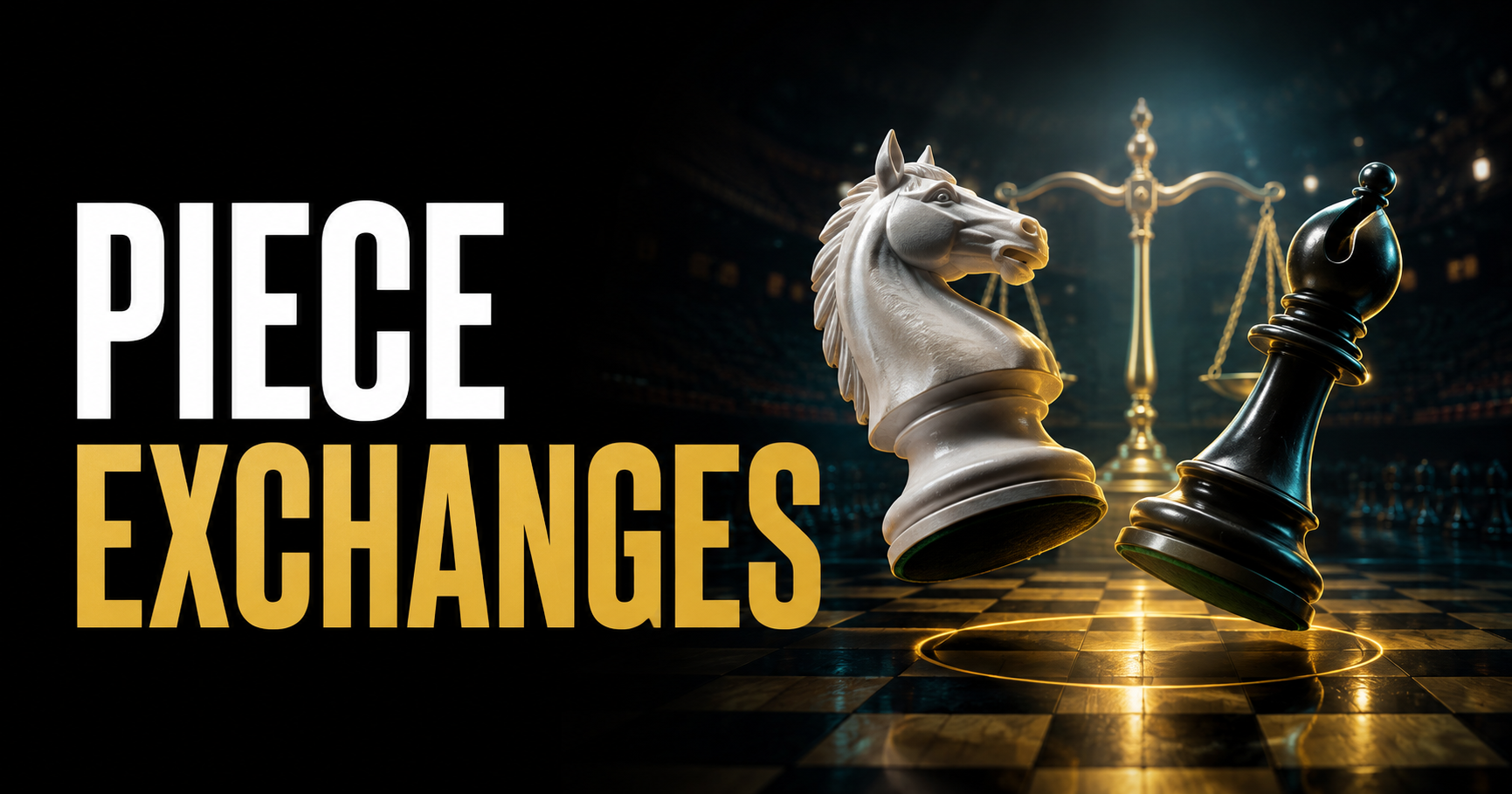
How To Decide Which Pieces To Exchange In Chess?
Many players treat exchanges as automatic: trade when ahead, avoid trades when attacking, swap a bishop for a knight if it wins a pawn. But strong chess is rarely that simple. ♟️ Every exchange changes the position’s geometry, removes possibilities, and creates a new version of the game.
The right question is not merely, “Is this piece worth the same?” It is: Which side benefits from the position that remains? 🔍 Learning to answer that question will sharpen your positional judgment and make your plans much clearer.
Exchanges Are Decisions, Not Rules
A bishop and a knight both carry a nominal value of three points, yet their practical value depends on the board. A bishop may dominate an open position, while a knight can become priceless on a protected outpost. Exchanging equal material can therefore produce a very unequal result.
🧭 Before every trade, imagine the position one move after the recapture. Which pieces remain? Which squares become weak? Which pawn structure appears? This short mental pause prevents many strategic mistakes.
Compare Activity, Not Just Material
If your opponent has one beautifully placed piece and one passive piece, exchanging the active piece is usually attractive. The same logic works in reverse: do not casually trade your best piece for an opponent’s worst one.
⚖️ Rate each piece by mobility, targets, defensive duties, and future potential. A rook trapped behind its own pawns may be less useful than an active minor piece, even though the rook is theoretically more valuable.
Remove The Defender That Holds Everything Together
Some pieces perform several defensive jobs at once. A knight may protect a mating square, block an open file, and defend a weak pawn. Exchanging or deflecting that single piece can make the entire position collapse.
🎯 Look for overloaded defenders and pieces that cannot be replaced. If removing one defender creates two threats, the exchange may be far more powerful than its material cost suggests.
Exchange Your Bad Piece
A strategically inferior piece is often worth trading even when the exchange looks neutral. A bad bishop locked behind its own pawns, a knight without useful squares, or a rook with no open file may become a long-term burden.
🔄 Trading that problem piece can release your whole position. The goal is not to preserve every unit—it is to improve the quality of the army that remains.
Think About The Pawn Structure
Every minor-piece exchange should be compared with the pawn structure. Knights enjoy closed positions and stable support squares. Bishops become stronger when pawns are spread across both wings and diagonals are open.
🧱 Ask whether the exchange creates a good-versus-bad bishop, leaves an untouchable knight, or produces weak pawns that one remaining piece can attack. The Master Chess Strategy course develops exactly this kind of structure-based evaluation.
Simplify When You Are Ahead—But Selectively
When you have extra material, exchanging pieces usually reduces the opponent’s attacking and tactical chances. However, exchanging pawns can sometimes make winning harder because fewer pawns remain to create a passed pawn.
✅ A useful rule is: when ahead in material, consider exchanging pieces before pawns. Still, calculate the resulting position. A winning middlegame can become a drawn rook ending if you simplify carelessly.
Keep Pieces When You Need Counterplay
If you are worse, active pieces are your source of complications. Trading them may leave you in a technically lost ending with no threats. Preserve the pieces that attack the king, create tactical ideas, or pressure multiple weaknesses.
🔥 Being worse does not mean refusing every exchange. Sometimes trading the opponent’s strongest attacker or entering a fortress is the best saving chance. Your decision must follow the position, not a slogan.
Check King Safety Before Trading Queens
A queen exchange can end an attack instantly—or destroy your own winning chances. If your king is exposed and the opponent’s queen is the main danger, simplification is often welcome. If their king is vulnerable, keeping queens may be essential.
👑 Compare the endgame honestly. Do not trade queens merely because it feels safe. First confirm that your remaining pieces, pawn structure, and king activity favor you.
Calculate The Forced Sequence
An attractive exchange can fail tactically because of an intermediate move, a recapture with another piece, or a discovered attack. Calculate every forcing reply before deciding that the trade improves your position.
🧠 The Calculation & Evaluation Technique course helps you compare candidate moves and evaluate the final position rather than stopping at the first exchange.
Picture The Endgame That Remains
Many exchange decisions are really endgame decisions in disguise. Trading rooks may activate the kings. Trading bishops may leave a knight dominating one color complex. Exchanging the final minor piece may create a pure pawn ending that is won—or lost.
🏁 When the position is simplifying, count pawn majorities, check opposition, identify passed-pawn races, and compare king routes. The Complete Endgame Course provides a structured foundation for recognizing these transitions.
A Practical Exchange Checklist
- Which piece is currently the strongest on the board?
- Am I trading my good piece for their bad piece?
- How will the pawn structure change after the recapture?
- Does the exchange improve or damage king safety?
- Which files, diagonals, and squares open afterward?
- Am I reducing counterplay or removing my own activity?
- Is the resulting endgame favorable and technically manageable?
📋 Run through this checklist during training until it becomes intuitive. In a real game, even three or four of these questions can dramatically improve your choice.
How To Train Exchange Decisions
Take a master game and stop before every major exchange. Write down which side should benefit and why. Then compare your prediction with the game and the annotations. This trains evaluation rather than memorization.
🧪 You can also revisit your own games and mark every voluntary trade. Was it necessary? What alternative kept more pressure? Which remaining piece became stronger? These small reviews reveal recurring strategic habits.
Final Thoughts
To decide which pieces to exchange in chess, compare activity, pawn structure, king safety, weak squares, counterplay, and the endgame that remains. Equal material does not mean an equal trade.
✨ The best exchanges make your plan easier and your opponent’s position harder. When you learn to evaluate the board after the trade—not just before it—your strategic decisions become far more precise.

You may also like

How to Study a Chess Course: 5 Easy Steps
How To Play Gambit Positions In Chess?