
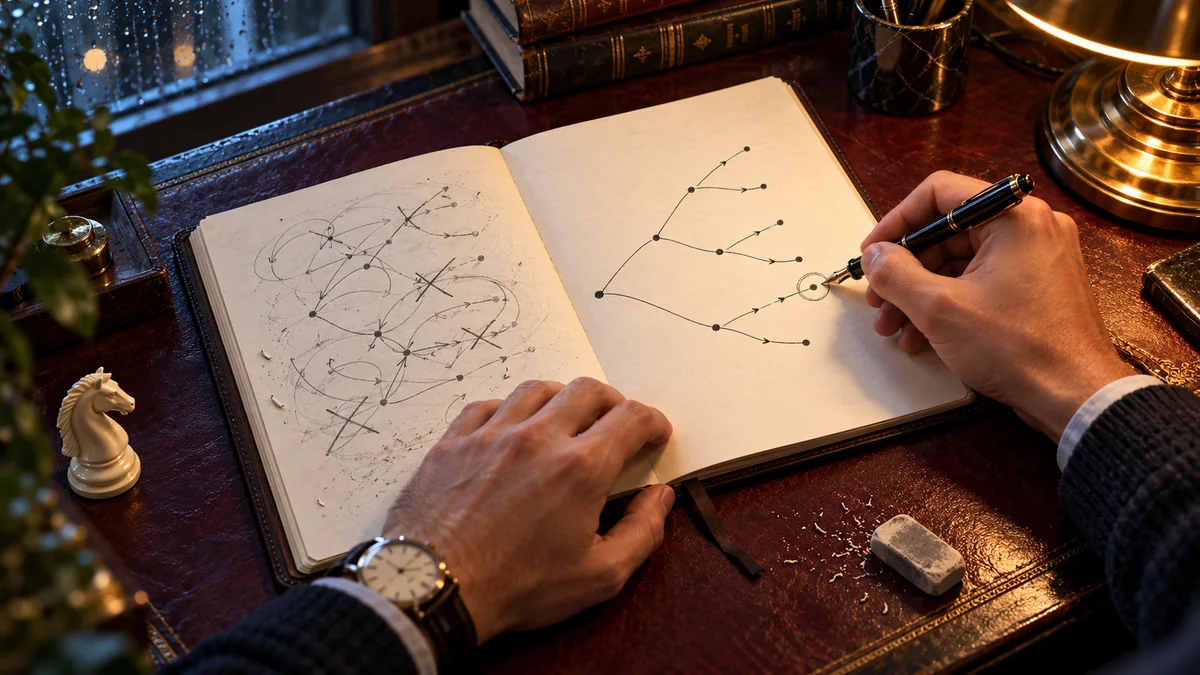
Calculation Discipline in Chess: 5 Ways to Stop Going in Circles
You examine an idea, look at another, then return to the first and repeat the same work. The clock runs, but the choice is no clearer. Calculation discipline in chess starts with asking what the next pass needs to establish.
Returning to an idea is useful when you discover a new reply, lose track of a detail or leave a question unfinished. These five habits help you distinguish those checks from repetition that adds little.
📍 In this guide
🎯 1. Finish with a usable conclusion
Before switching to another candidate, summarise what you have learned. “Looks interesting” is difficult to compare. “The immediate threat is covered, but I have not assessed the resulting activity” identifies both progress and unfinished work.
Keep three things in mind: your current assessment, the reason for it and the uncertainty that could change it. The conclusion can be provisional. Its purpose is to give your next comparison a starting point, not to make you defend your first impression.
🔎 2. Name the reason for another pass
When you return to an idea, ask: “What am I checking this time?” Useful answers are specific: a reply you omitted, an assumption you never tested, or a detail you can no longer picture reliably.
- New possibility: examine whether it changes your conclusion.
- Unfinished assessment: continue from the unresolved question.
- Unclear mental picture: rebuild the relevant part carefully.
- Same work, no new question: consider comparing the conclusions you already have.
A vague doubt can still conceal something important. Try to turn it into a concrete objection before dismissing it or restarting the whole calculation.
🧩 3. Repair the part that changed
Suppose you discover that an earlier assumption was wrong. Ask which conclusions depended on it. Recheck those parts rather than automatically discarding every candidate you examined.
Be willing to reopen a rejected option too. If your reason for rejecting it no longer holds, it deserves another look. Discipline includes correcting your work.
Do not carry forward a conclusion whose supporting details you have lost. Saving a few seconds is little help if the comparison rests on an unreliable picture. Return to the actual position and reconstruct what you need.
🛡️ 4. Give the final check a clear job
Once you prefer a move, challenge it from the opponent’s side. Look for forcing replies and for the particular assumption your choice depends on. Ask what a strong response would do to your intended result.
If that check reveals a flaw, reopen the decision. If it confirms your reasoning without exposing a new problem, avoid automatically replaying every alternative.
There is no useful universal rule that every line must be checked exactly once or twice. Give attention to unresolved issues that could change the decision, taking the remaining time into account.
📝 5. Review what each pass added
During individual training, record three short items after an attempt: why you returned to an idea, what you checked and whether your conclusion changed. Keep written reasoning logs for study or post-game review.
Then compare your work with checked analysis. A second pass that found an overlooked resource was valuable. A quick first pass based on a false assumption needs correction. Counting repetitions alone cannot tell you whether you calculated well.
For the wider review process, see how to analyse your games.
🧪 A small practice test
Try this at your next independent calculation session. Before revisiting a candidate, state the missing question in a few words. Afterward, compare these two imaginary notes:
- Useful return: “I overlooked a defensive possibility, checked it and changed my assessment.”
- Circular return: “I replayed the same reasoning but could not identify anything new.”
For the next exercise, work on one adjustment: ending each pass with a conclusion you can compare. Continue to revise it when new evidence appears. The aim is a clearer decision, not a perfect record of never looking twice.

You may also like
How to Study a Chess Course: 5 Easy Steps
Gambit Positions in Chess: 5 Keys to Strong Compensation