
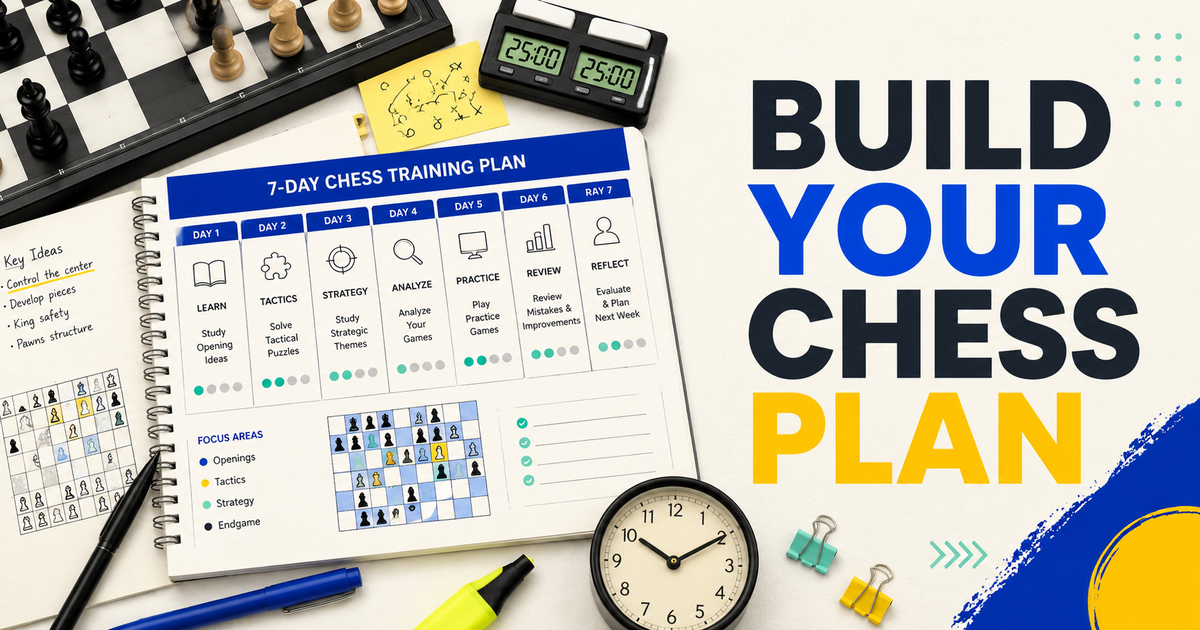
How To Build A Chess Training Plan?
A good chess training plan turns motivation into repeatable work. Instead of studying whatever feels interesting that day, you give each weakness enough focused attention to improve. 📅 Structure creates consistency without making training rigid.
The best plan is not the most complicated one. ✅ It matches your available time, competitive goals, and current mistakes. A realistic schedule repeated for months will outperform an ambitious plan abandoned after one week.
Start With A Clear Goal
Choose a goal connected to your actual games: reduce tactical blunders, understand middlegame plans, improve rook endings, or prepare for an event. Rating can be a long-term indicator, but it should not be the daily target.
🎯 Define one primary goal for the next six to eight weeks. Too many equal priorities divide attention and make progress difficult to measure.
Audit Your Recent Games
Analyze ten to twenty serious games and classify the main errors. Separate opening knowledge, calculation, evaluation, planning, time management, endgame technique, and psychology.
🔍 Count repeated problems rather than dramatic one-time mistakes. If five games contained poor candidate generation, that weakness deserves more training than one rare opening trap.
Choose The Core Training Areas
Most plans should include calculation, strategy, endgames, opening maintenance, game analysis, and serious play. The percentage devoted to each area depends on your audit.
⚖️ Keep a balanced foundation while emphasizing the biggest weakness. Even an opening specialist still needs calculation, and a tactical player still needs structural understanding.
Prioritize Active Training
Active training requires you to make decisions: calculate a position, predict a move, evaluate an ending, or analyze your game. Passive content can explain ideas, but it should support—not replace—active work.
🧠 Write variations and conclusions before checking the solution. Effortful retrieval creates stronger memory and exposes the exact point where your thinking fails.
Plan Calculation Sessions
Use a mix of easy pattern repetition and deep positions. Easy work improves recognition; harder work develops candidate generation, visualization, and evaluation.
⚡ Two or three focused sessions per week are enough when the work is serious. The Calculation & Evaluation Technique course offers a structured method for this central part of training.
Plan Strategic Study
Study model games in structures from your repertoire. Pause at critical moments, identify imbalances, propose a plan, and compare your decision with the annotated game.
🧭 Focus on reusable patterns: pawn breaks, weak squares, piece routes, favorable exchanges, and restriction. The Master Chess Strategy course can organize this work around clear positional themes.
Include Endgame Training
Divide endgame work between essential theory and practical positions. Review king-and-pawn endings, rook activity, minor-piece endings, and conversion of an extra pawn.
👑 Short weekly sessions maintain knowledge better than rare marathons. The Complete Endgame Course provides a systematic path through theoretical and practical endings.
Keep Opening Work Efficient
Openings should prepare you to reach understandable positions, not consume the entire schedule. Review recurring lines, typical plans, tactical ideas, and mistakes from recent games.
📚 Maintain concise files and update them after serious play. Avoid collecting thousands of engine moves that you cannot explain or remember.
Analyze Every Serious Game
Review games without an engine first. Reconstruct candidates, evaluations, clock times, and emotional decisions. Then use an engine to verify important variations.
📝 Game analysis connects every training area. It shows whether your work is transferring to competition and supplies positions for future sessions.
Schedule Serious Practice
Play at a time control that allows your thinking process to operate. Treat practice like competition: remove distractions, record moves, and conduct a post-game review.
♟️ Blitz can support pattern recognition and opening exposure, but it should not be the only form of play if your goal is deeper decision-making.
Use Weekly Themes
A weekly theme creates depth without neglecting balance. For example, keep calculation and game analysis constant while emphasizing isolated-pawn structures one week and rook endings the next.
🔄 Themes make study feel connected. You begin seeing the same idea in puzzles, model games, and your own positions.
Build A Realistic Weekly Schedule
- Monday: 45 minutes calculation and tactical review.
- Tuesday: 45 minutes model-game strategy.
- Wednesday: rest or 20 minutes opening maintenance.
- Thursday: 45 minutes endgame training.
- Friday: 30 minutes calculation and 30 minutes game analysis.
- Weekend: one serious practice game plus review.
⏳ Adjust the duration to your life. If you have only thirty minutes per day, shorten the sessions while preserving focus and consistency.
Use A Simple Session Structure
- Define the exact skill and objective.
- Work without distractions for a fixed period.
- Check answers only after completing your own analysis.
- Record errors and one reusable lesson.
- Schedule the next review.
🔧 A repeated structure reduces preparation time. You begin training immediately instead of spending half the session deciding what to do.
Track The Right Metrics
Record sessions completed, puzzle accuracy, recurring error types, and whether a lesson appeared in a later game. Avoid judging the plan only by short-term rating changes.
📊 Useful progress includes fewer blunders, better time use, clearer plans, and stronger endgame decisions. These improvements often appear before the rating follows.
Review The Plan Every Four Weeks
Keep what works, reduce what you consistently avoid, and update priorities based on new games. A plan should evolve with your needs rather than remain frozen.
🛠️ If a schedule repeatedly fails, make it smaller and more specific. Sustainability is a performance feature, not a compromise.
Use Guided Structure When Needed
Some players know what to study but struggle to organize progression. A guided program can reduce decision fatigue and provide a balanced sequence.
🚀 The Chess Training Program combines key improvement areas into a practical framework that can support your weekly schedule.
Common Training-Plan Mistakes
Common mistakes include studying only openings, solving puzzles by guessing, changing resources constantly, training without game analysis, and scheduling more hours than life allows.
❌ Another mistake is never reviewing old material. Spaced repetition turns a good lesson into a usable pattern.
Final Thoughts
To build a chess training plan, begin with evidence from your games, choose one primary goal, balance the core skills, and schedule active work that fits your real week.
🌟 A plan succeeds through repetition. Train, play, analyze, adjust—and let each cycle become slightly more focused than the last.

You may also like

How to Study a Chess Course: 5 Easy Steps

How To Play Gambit Positions In Chess?