
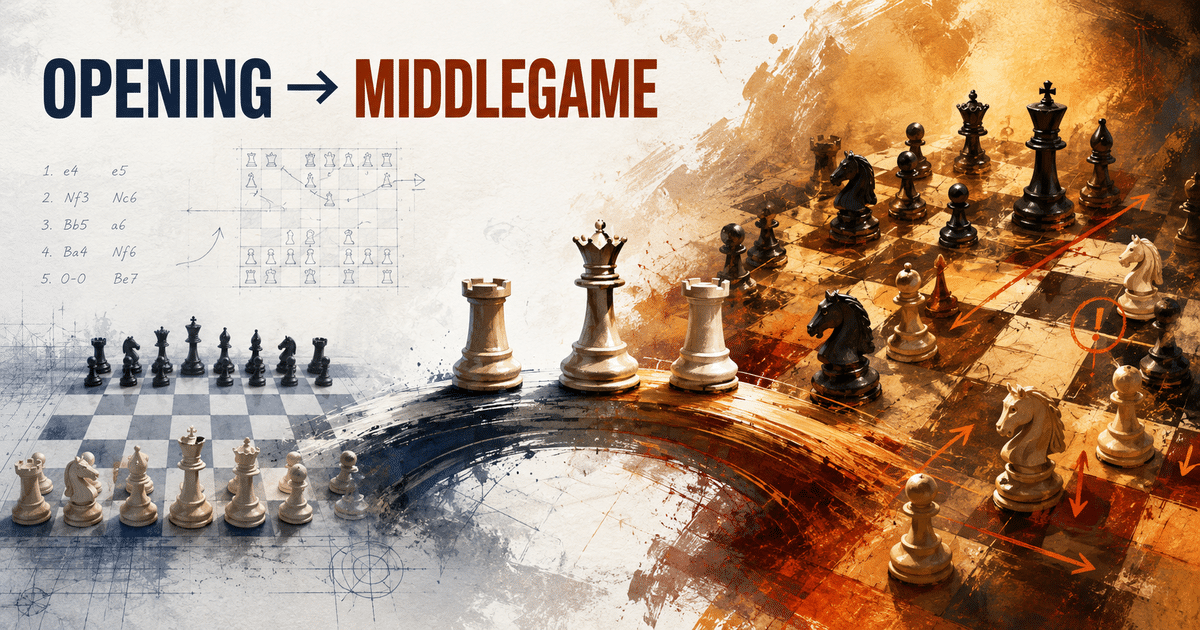
How To Transition From The Opening To The Middlegame?
Many players know their opening moves but feel lost when the memorized line ends. The position is playable, yet no obvious instruction remains. 🧭 The transition from opening to middlegame is where knowledge must become understanding.
A smooth transition requires three things: recognize what the opening created, finish any unfinished development, and choose a plan that fits the pawn structure. ♟️ Once these questions are clear, you no longer need to remember every move.
When Does The Opening End?
There is no fixed move number. The opening ends when the main development and king-safety tasks are largely complete and the position’s strategic direction becomes more important than theory.
🚦 The transition may begin on move eight in a quiet sideline or move twenty in a sharp theoretical battle. Judge the position, not the move counter.
Do Not Switch Off After Theory
A common mistake is playing memorized moves quickly and then making the first natural move after memory ends. Instead, pause immediately when the position becomes yours to solve.
⏸️ Reevaluate material, king safety, development, pawn structure, weak squares, and tactical possibilities. The opponent may have deviated in a way that changes the usual plan.
Finish Development Before Starting An Attack
Check whether every minor piece has a useful square, whether the king is safe, and whether the rooks are connected. An undeveloped piece often becomes the reason a promising attack fails.
🔧 Development is not merely moving pieces once. A bishop blocked behind its own pawn may still require a plan before the middlegame position is fully coordinated.
Identify The Pawn Structure
The structure tells you where space exists, which breaks are available, and which pieces are good or bad. Name the central formation and compare it with model positions you know.
🧱 Ask whether the center is open, closed, or flexible. The Master Chess Strategy course develops the connection between pawn structure, piece placement, and middlegame plans.
Find The Thematic Pawn Break
Most openings aim toward one or two important breaks. Identify which break you want, which pieces support it, and what must be prepared first.
🔨 Do not play the break simply because it is thematic. Calculate the exchanges, open lines, weak squares, and resulting piece activity in the current position.
Compare The Best And Worst Pieces
Locate each side’s most active and least useful piece. Your first middlegame plan often involves improving the worst piece or restricting the opponent’s best one.
🎯 A simple reroute may be more important than an immediate attack. If every piece contributes, tactical opportunities become easier to create.
Understand The Opening’s Exchange Rules
Every structure contains favorable and unfavorable exchanges. A knight may be essential for controlling a key break, while a bishop may be needed to protect weak squares around the king.
⚖️ Before trading, picture the position after the recapture. Do not exchange automatically because theory once used a similar trade.
Check Both Sides’ Plans
State your ideal setup, then state the opponent’s. Who wants to open the center? Who benefits from queen exchanges? Which wing offers more space?
🔍 A strong move often advances your plan while making the opponent’s plan slower. This is the practical bridge between opening knowledge and middlegame strategy.
Recognize Critical Transitions
The most important moments include the first central break, a major exchange, the opening of a file, a change in king safety, or the decision to close the center.
⚡ Slow down before irreversible choices. The Calculation & Evaluation Technique course helps organize candidate moves and verify strategic decisions through concrete variations.
Use Your Opening Notes Correctly
Opening files should contain more than moves. Add typical plans, model games, tactical themes, weak squares, and common endgame transitions.
📚 A short explanation is easier to retrieve than fifty engine moves. When your opponent deviates, the idea remains useful even if the exact sequence disappears.
Study Model Games From Your Repertoire
Choose games that reach the structures you play. Pause after the opening and predict the first plan, piece maneuver, or pawn break. Then follow how the position develops.
🌟 Look for repeated routes and exchanges. Patterns are what make a repertoire playable beyond memorization.
Handle An Early Opponent Deviation
When the opponent leaves theory, do not assume the move is bad. Identify what it gains and concedes. Continue with development and central control unless a concrete opportunity exists.
🛡️ Trying to punish every unusual move can create unnecessary weaknesses. Sound chess is often the strongest response.
Transition Into An Attack
An attack is justified when development, king safety, open lines, and piece concentration support it. Count attackers and defenders and identify the pawn break or sacrifice that opens access.
🔥 The Attacking Mastery course shows how opening advantages become coordinated middlegame attacks rather than premature aggression.
Transition Into An Endgame
Before simplifying, evaluate the pawn structure, king activity, minor-piece quality, and passed-pawn possibilities. A favorable opening does not guarantee a favorable ending.
👑 If the queen exchange fits your structure and reduces counterplay, it may be the cleanest plan. The Complete Endgame Course supports accurate judgment of these transitions.
A Transition Checklist
- Has my opponent changed the normal structure or plan?
- Is my king safe and development complete?
- What is the central pawn structure?
- Which pawn break matters most?
- What are the best and worst pieces?
- Which exchanges favor each side?
- What is the opponent’s main plan?
- Which candidate move begins my middlegame plan?
📋 Use the full checklist when theory ends or the structure changes. With experience, the most important questions become automatic.
Common Transition Mistakes
Common errors include playing too quickly after memory ends, attacking before development is complete, copying a standard plan from a different structure, and exchanging important pieces automatically.
❌ Another mistake is spending too much time trying to remember theory instead of solving the position. The board is always the final authority.
How To Practice The Transition
Take positions from your repertoire at the point where theory usually ends. Without an engine, write the structure, plans, break, piece improvements, and two candidate moves.
📝 Compare with model games and update your opening notes with the explanation. This turns preparation into usable middlegame understanding.
Final Thoughts
To transition from the opening to the middlegame, stop when memory ends, evaluate the new position, finish development, and let the pawn structure guide your plan.
🚀 Opening knowledge should deliver more than a familiar position. It should give you the clues needed to play the next phase with confidence and purpose.

You may also like

How to Study a Chess Course: 5 Easy Steps

How To Play Gambit Positions In Chess?