
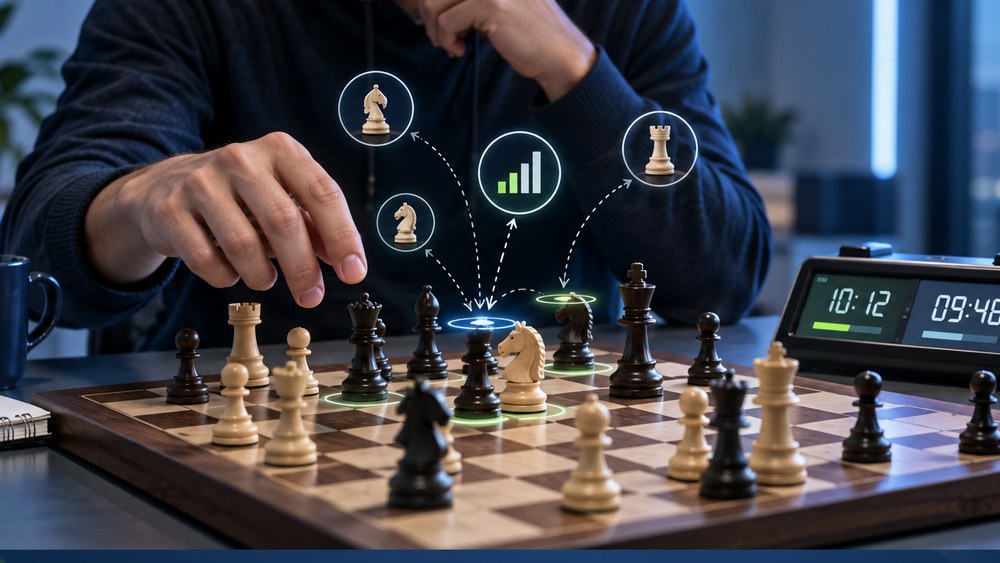
How To Improve At Rapid Chess?
⏱️ How To Improve At Rapid Chess requires balancing calculation with practical decision-making. Rapid gives enough time to think deeply at critical moments, but not enough to solve every position from the beginning.
Use your thinking time where it can change the result. In rapid chess, a reliable routine is more useful than calculating every move to the same depth. Identify the critical choice, compare realistic options, and leave time for a final blunder check.
⏱️ Rapid chess: recognise decisions that deserve time
Strong rapid players recognize when a position deserves time. Routine development, forced recaptures, and familiar structures should be handled efficiently. Tactical turning points and irreversible pawn moves receive the larger share of the clock.
Your improvement comes from a repeatable thinking process: scan threats, select candidates, calculate the most forcing line, and make a final blunder check.
🔍 When Should You Look For It?
- You spend too long in familiar opening positions
- Critical moments are played instantly
- You reach playable positions with almost no time
- Simple blunders occur after long calculations
- Post-game analysis reveals poor time allocation
These signs do not replace calculation, but they tell you when the position deserves extra attention. The more of them that appear together, the more likely the theme is to affect the best move.
🧭 A Step-By-Step Plan
- Set time landmarks: Know how much time you want remaining after the opening and middlegame.
- Recognize critical moments: Slow down for tactics, pawn breaks, exchanges, and king-safety decisions.
- Limit candidate moves: Compare two or three realistic choices instead of calculating everything.
- Use a final safety check: Before moving, inspect the opponent’s checks, captures, and threats.
- Analyze without an engine first: Find the decision error before checking computer evaluations.
Work through the steps in order until the process becomes natural. In a practical game, you may complete the scan in seconds because the relevant relationships are already familiar.
♟️ A Practical Example
In a 15+10 game, spending five minutes on a normal opening move creates future pressure without improving the position. Saving those minutes for a complicated middlegame decision often produces a much better practical result.
Notice that the correct decision comes from the position’s demands rather than a slogan. Good chess principles guide your search, while concrete calculation confirms the move.
❌ Common Mistakes
- Playing rapid exactly like blitz
- Using half the clock on one non-critical choice
- Calculating many moves but skipping the opponent’s forcing reply
- Checking the engine before writing your own analysis
The most dangerous mistake is using a correct idea in the wrong position. Always compare the strategic plan with immediate tactical details before committing.
🎯 A Training Method That Works
Play a small set of serious rapid games each week. Mark the time after moves 10, 20, and 30, and identify the true critical moment afterward. Review whether your clock use matched the difficulty of the decisions.
Keep the exercises short enough to repeat consistently. Regular focused sessions create stronger pattern recognition than one long session followed by several weeks without practice.
✅ Quick Checklist
- Set time landmarks
- Recognize critical moments
- Limit candidate moves
- Use a final safety check
- Analyze without an engine first
Use this checklist during training first. With repetition, it becomes a fast internal scan that supports better decisions without consuming too much time.
♟️ Coach’s Practical Test
Play three rapid games with a fixed thinking routine: identify the opponent’s threat, generate two candidates, calculate the forcing line, and perform a final blunder check. Record the clock time at moves 10, 20, and 30.
During review, classify each mistake as knowledge, calculation, or time management. Do not begin with the engine. First explain what your decision process missed, then use analysis to test that explanation. Rapid improvement comes from making the routine reliable under a real but manageable clock.
🎯 Review both the moves and the clock in rapid chess
After a game, choose one moment where you spent a lot of time and one where you moved almost immediately. Hide the continuation and explain the decision again. Was the long think necessary? Did the instant move overlook a change in the position?
A useful review note has three parts: what I noticed, what I calculated, and what I failed to check. For example: I saw a weak pawn, calculated a capture, but never checked the opponent’s forcing reply against my king. That diagnosis gives your next training session a clear task.
In a 15+10 game, clock landmarks can help you notice a pattern, but they are not rules that override the board. A forcing tactical position may deserve several minutes. A familiar developing choice may not. Review whether your time expenditure matched the uncertainty and consequences of the decision.
Practise the same routine on a lesson position: name the threat, list two candidates, calculate the strongest reply, and recheck the final position. Keep any engine assistance for study and post-game review, never for an ongoing game against another player.
💬 Rapid chess questions
How many candidate moves should I consider?
Begin with two or three realistic choices. Add another when the initial candidates fail or when a forcing move changes the picture. The aim is not to restrict calculation artificially, but to avoid spending the whole clock on moves that do not address the position.
Should I analyse with an engine immediately?
Write your own explanation first. Then use the engine to test specific questions: was the sacrifice sound, was there a defensive resource, or did a different move order matter? An evaluation alone does not explain why you made the mistake.
What should I train between rapid games?
Use the recurring weakness from your review. If you keep entering inferior endings, practise those endings. If your calculations stop one move too soon, solve a smaller set of positions while writing the opponent’s best reply. Avoid changing training topics after every result.
Continue with game-analysis habits and handling tournament nerves. The Lichess puzzle themes offer additional positions for a focused study session.
Final Thoughts
Improve at rapid chess by spending time according to importance. Build a compact thinking routine, slow down at irreversible moments, and analyze both moves and clock decisions.
🌟 Improvement comes from recognizing the right moment, following a clear process, and reviewing the result honestly. Apply the idea in your own games until it becomes part of your natural thinking.

You may also like
Basic Checkmates in Chess: 5 Easy Steps to Confident Wins

How To Practice Blindfold Chess?