How To Improve Chess Visualization? 8 Effective Exercises
Chess visualization is the ability to see positions, moves, and tactical changes in your mind without physically moving the pieces. It is one of those skills that seems almost mysterious when a strong player calculates a long variation—but it is not magic. 🧠 It is a trainable ability built through accurate, focused practice.
If you frequently lose track of where a piece moved, miss a defender at the end of a variation, or calculate a beautiful line only to discover that the final position is unfavorable, visualization is probably the missing link. The good news is that you do not need a photographic memory. You need a reliable method and exercises that become gradually more demanding.
What Is Chess Visualization?
Chess visualization means maintaining a correct mental picture of the board as the position changes. When you imagine 1.Bxh7+ Kxh7 2.Ng5+, you should know which squares have become empty, which lines have opened, and what every relevant piece can do. In practical play, visualization works together with calculation and evaluation: first you imagine the moves, then you judge the resulting position.
Strong visualization does not mean seeing twenty moves ahead in every position. 🎯 It means seeing the necessary moves clearly enough to make a trustworthy decision. Sometimes that is a three-move tactical sequence; sometimes it is a quiet endgame maneuver whose consequences appear much later.
Why Visualization Errors Cause Blunders
Many calculation mistakes are not caused by a lack of chess knowledge. They happen because the mental board becomes inaccurate. A captured pawn remains in your imagination, a rook is forgotten on an open file, or a bishop is mentally placed on the wrong diagonal. Once the picture is wrong, even logical analysis produces the wrong conclusion.
Improving visualization therefore reduces several types of errors at once: missed tactics, illegal imagined moves, forgotten defenders, and inaccurate evaluations. 🔍 It also saves time because you no longer need to recalculate the same line simply to remember where the pieces are.
1. Name Every Square Without Looking
Start with the coordinates. Choose a square such as e5 and immediately identify its color, neighboring squares, diagonals, and distance from the edges. Then do the same with random squares. This simple exercise strengthens your internal map of the board.
You can make it more practical by asking questions: Which squares can a knight attack from c4? On which diagonal do b1 and h7 lie? Can a bishop on g2 reach b7? ⚡ Aim for quick, accurate answers rather than speed alone. Five minutes a day is enough to create noticeable improvement.
2. Follow A Piece Around An Empty Board
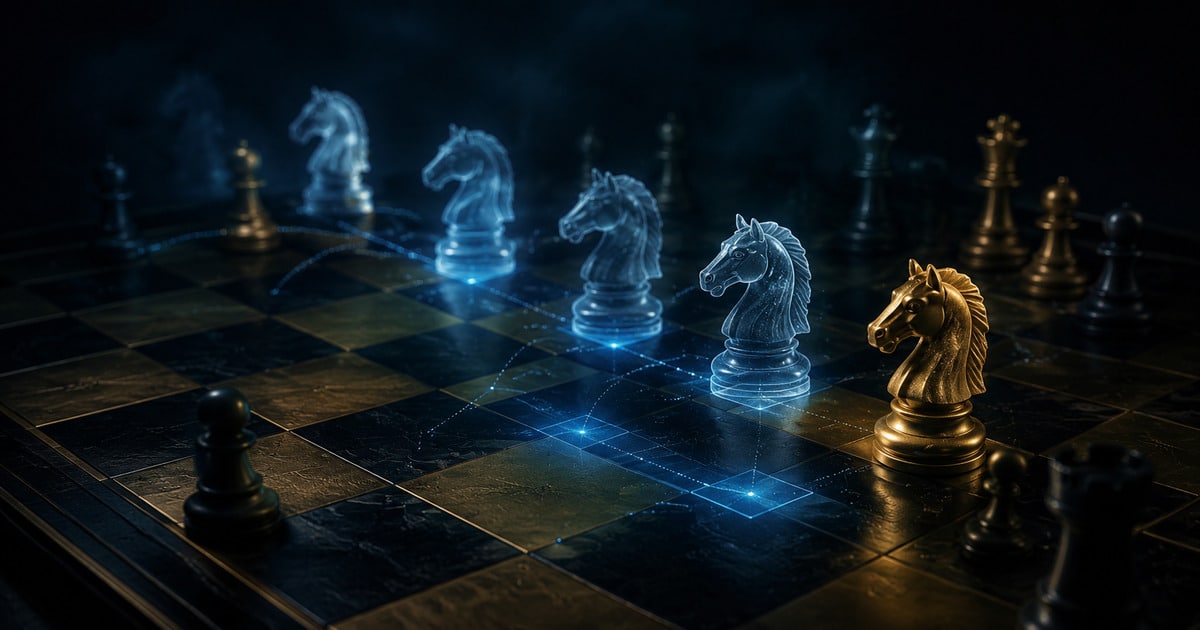
Visualize an empty board and place one piece on a starting square. Move it mentally through a short sequence, saying each destination aloud. For example: a knight starts on g1, then goes to f3, e5, c4, and b6. At the end, state every square it attacks.
Begin with rooks and bishops because their paths are easier to trace. Add knights next, then combine two pieces whose routes intersect. ♞ This develops the ability to preserve piece locations while the position changes—a core requirement for accurate calculation.
3. Replay A Short Game From Notation
Take a miniature game of fifteen to twenty moves and read the notation without using a board. After every two or three moves, pause and describe the position: where are the queens, which pawns have moved, and which files or diagonals are open? Then check the actual board.
Do not worry if your first attempt breaks down early. Return to the last position you visualized correctly and continue from there. ✅ Accuracy is the objective. As you improve, increase the number of moves between checks and eventually replay an entire short game in your mind.
4. Solve Tactics Without Moving The Pieces
Tactical puzzles are excellent visualization training when you resist the temptation to drag pieces on the screen. Identify candidate moves, calculate each forcing line, and state the final position before making the first move. Include material count, king safety, and the location of the major pieces.
Use positions that are challenging but solvable. If every puzzle requires fifteen minutes, you will mostly train frustration. A useful set should allow you to calculate several clean variations in one session. For a structured approach to candidate moves and variation control, the Calculation & Evaluation Technique course provides a systematic framework.
5. Use The ‘Move, Update, Scan’ Method
After every imagined move, deliberately update your mental board. First remove any captured piece. Next relocate the moving piece. Then scan the changed ranks, files, and diagonals. 🔄 This tiny routine prevents the most common visualization failure: continuing to calculate from an outdated position.
Suppose a bishop captures on h7. The bishop is no longer on its original diagonal, the h7-pawn is gone, the h-file may have changed, and the king may now have new legal responses. Treating each move as a complete board update makes longer variations much more stable.
6. Practice ‘What Changed?’
Study a position for thirty seconds, make one move on the board, and list everything that changed beyond the obvious relocation. Did a piece become undefended? Did a file open? Was a square weakened? Did the move create a discovered attack or remove a defender? 👀
This exercise connects visualization with chess meaning. You are not merely remembering coordinates; you are recognizing how a move transforms the position. During a real game, that skill helps you notice an opponent’s threat before automatically continuing with your own plan.
7. Calculate From The End Position Backward
Choose a short forcing line and calculate it normally. Once you reach the final position, reconstruct the route backward: what was the previous move, which piece occupied the square before that, and when did the tactical feature appear? Backward reconstruction exposes details that disappeared from your mental board.
It is especially useful for exchanges. After a sequence on one square, verify which piece remains, what material was removed, and which side gained a tempo. 🧩 Many practical mistakes come from calculating the moves correctly but miscounting the final material.
8. Visualize Quiet Positions, Not Only Tactics
Tactical sequences are forcing, which makes them easier to organize. Quiet positions demand a broader picture. Select a strategic position and visualize three sensible moves for each side. Then describe the resulting pawn structure, best and worst pieces, weak squares, and possible plans.
This is where visualization becomes genuinely useful for positional play. You learn to foresee not only attacks but also improved piece placement and long-term structural changes. The Master Chess Strategy course can help you connect that mental picture to concrete strategic decisions.
A Simple 20-Minute Visualization Routine
- Spend 3 minutes naming square colors and piece routes.
- Spend 5 minutes replaying notation without a board.
- Spend 8 minutes solving two or three tactics entirely in your head.
- Spend 4 minutes checking the final positions and recording each error.
Keep the routine short enough to repeat consistently. 📅 Three or four focused sessions per week are more valuable than one exhausting session followed by a long break. Record the type of mistake you made—forgotten piece, wrong square, missed capture, or inaccurate final evaluation—so your training addresses a specific weakness.
Common Visualization Training Mistakes
The first mistake is attempting variations that are far beyond your current level. Difficulty should increase gradually. The second is checking the board after every move, which removes the mental challenge. The third is never checking at all; without feedback, you may rehearse an incorrect picture.
Another mistake is treating visualization as a memory contest. Chess positions are easier to hold when you understand their relationships. A knight is not simply ‘on f3’; it defends h4 and e5, blocks the f-pawn, and may support a kingside attack. Meaning creates stronger mental anchors than isolated coordinates.
How Long Does It Take To Improve?
Most players notice cleaner short calculations within a few weeks of regular training. Longer and more complex visualization develops over months. Progress is rarely linear: one day the board feels clear, and another day a simple line seems difficult. That variation is normal.
Measure improvement through accuracy, not the maximum number of moves you can claim to see. 📈 If you calculate a five-move sequence correctly, remember the final position, and evaluate it well, that is more useful than imagining ten uncertain moves.
Final Thoughts
Better chess visualization comes from disciplined updates, frequent verification, and exercises that stretch you without overwhelming you. Build a clear map of the board, track every change after each move, and connect the imagined position to concrete chess ideas.
Start with one exercise today and repeat it for a week. 🏁 When your mental board becomes more reliable, calculation feels calmer, tactics become easier to confirm, and your decisions gain confidence. Visualization is not a gift reserved for masters—it is a practical skill you can strengthen one accurate position at a time.

You may also like
How to Study a Chess Course: 5 Easy Steps
How To Play Gambit Positions In Chess?