
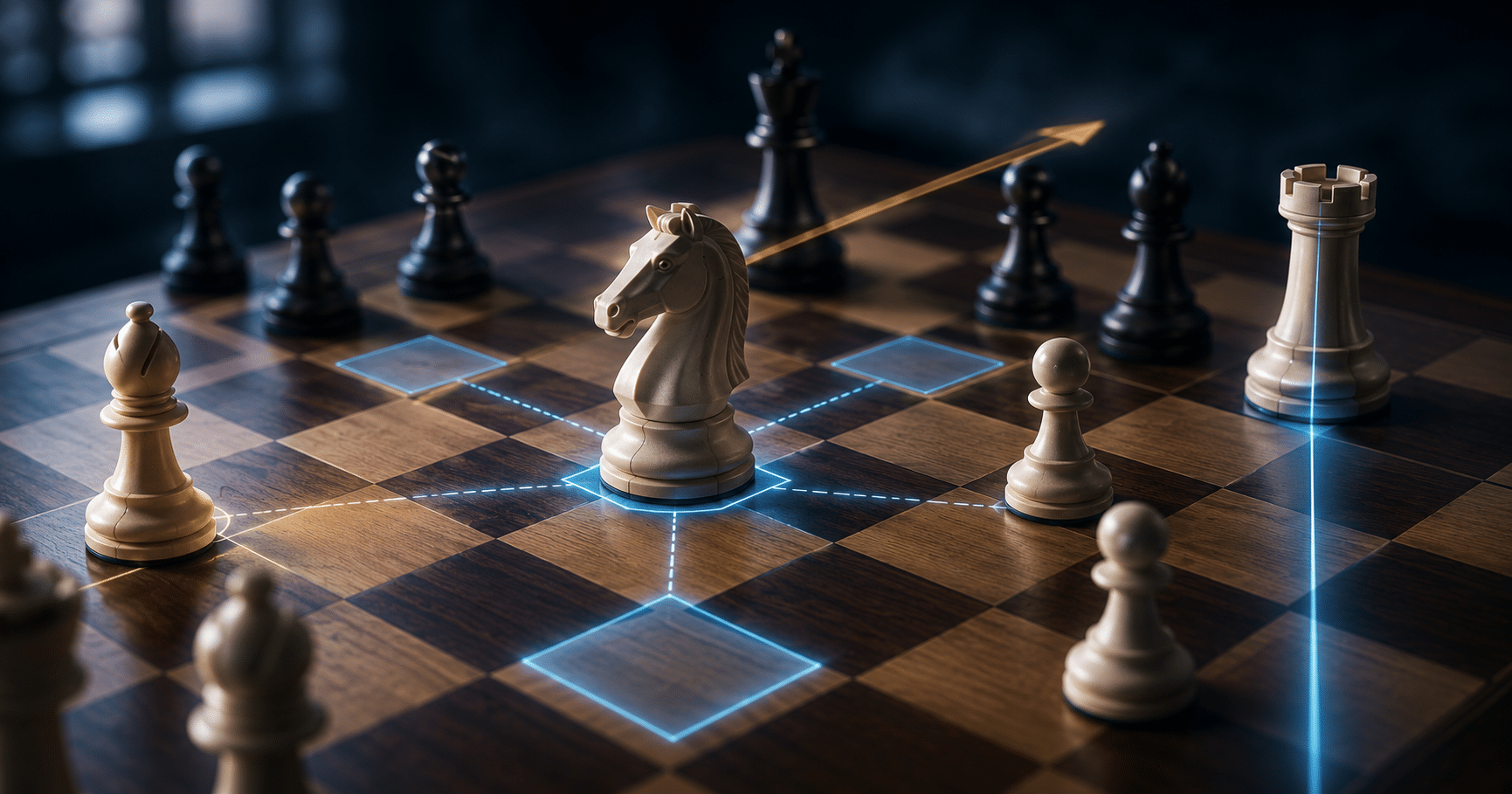
How To Improve Positional Chess?
♟️🧠 Positional chess is not boring — it is powerful.
🔥 Many players think improvement only comes from tactics, attacks, and opening theory.
But very often, the player who understands positional chess better controls the game without needing a direct tactic.
🎯 They place pieces on better squares.
♟️ They understand pawn structures.
🧱 They create weaknesses.
🔄 They exchange the right pieces.
🏆 They slowly improve the position until the opponent has no good moves.
If you want to learn how to improve positional chess, you need to understand how strong players think when there is no immediate tactic.
Positional chess is the art of making your position easier to play — and your opponent’s position harder to play.
♟️ 1. Improve Your Worst Piece
This is one of the simplest and most powerful positional rules.
When you do not know what to do, ask:
“What is my worst piece?”
Maybe your knight has no good square.
Maybe your bishop is blocked by your own pawns.
Maybe your rook is not on an open file.
Maybe your queen is active, but the rest of your pieces are passive.
Maybe your king is unsafe, limiting your options.
Strong players constantly improve their pieces.
They do not make random moves.
They ask:
🔷 Which piece is doing the least?
🔷 Where does this piece belong?
🔷 Can I move it to a better square?
🔷 Can I prepare an outpost?
🔷 Can I open a file for my rook?
Improving one bad piece can completely change the position.
This is one of the main ideas behind Middlegame Planning, because good plans often start with improving your worst piece.
🎯 2. Understand Weak Squares
A weak square is a square that pawns cannot easily defend.
Weak squares are extremely important in positional chess.
If you control a weak square, you may be able to place a knight, bishop, queen, or rook there and create long-term pressure.
Common weak-square examples:
♟️ a hole on d5
♟️ a weak square near the king
♟️ a central square that cannot be challenged
♟️ an outpost for a knight
♟️ dark-square or light-square weaknesses
Strong positional players not only attack pieces; they also defend them.
They attack squares.
Before choosing a plan, ask:
🔷 Which squares are weak?
🔷 Can I put a piece there?
🔷 Can my opponent remove it?
🔷 Which color complex is weak?
🔷 Can I create a new weakness?
When you start seeing weak squares, your understanding of the middlegame deepens.
🧱 3. Learn Pawn Structures
Pawn structures decide plans.
Many players focus only on pieces, but strong players pay close attention to pawns.
Pawns show you:
🔷 where the space advantage is
🔷 Which files may open
🔷 Which squares are weak
🔷 where the pawn breaks are
🔷 Which side should attack
🔷 Which endgames may be good or bad
For example, an isolated queen’s pawn position has different plans than a closed center.
A hanging pawns structure has different plans than a minority attack.
A fixed pawn chain has different plans than an open center.
If you do not understand the pawn structure, you will often choose the wrong plan.
Ask yourself:
♟️ Where is my pawn majority?
♟️ Which pawn breaks are possible?
♟️ Are my pawns flexible or fixed?
♟️ Which weaknesses can I attack?
♟️ Which side of the board should I play on?
Understanding pawn structure is one of the foundations of Master Chess Strategy, because strategy begins with knowing what the position is asking for.
🔄 4. Exchange The Right Pieces
Exchanges are one of the most underrated positional skills.
Many players trade pieces automatically.
Strong players trade with a purpose.
Before exchanging, ask:
🔷 Am I trading my bad piece for their good piece?
🔷 Am I removing an important defender?
🔷 Am I improving my pawn structure?
🔷 Am I entering a better endgame?
🔷 Am I reducing their counterplay?
🔷 Am I giving up my active piece?
A good exchange can make your position much easier to manage.
A bad exchange can destroy your advantage.
For example:
♟️ Trading your passive bishop for an active knight may be excellent.
♟️ Trading queens may help if your king is weak.
♟️ Trading rooks may be bad if your rook is more active.
♟️ Trading into a worse endgame can ruin a good position.
Positional chess is not only about keeping pieces.
It is about knowing which pieces belong on the board.
🏰 5. Control Open Files
Rooks need open files.
A common positional mistake is leaving rooks passive while focusing only on minor pieces.
If there is an open file, ask:
🔷 Can I place a rook there?
🔷 Can I double rooks?
🔷 Can I invade the seventh rank?
🔷 Can I pressure a backward pawn?
🔷 Can my opponent control the file first?
Open files often decide middlegames and endgames.
A rook on an open file can create pressure without immediate tactics.
It can restrict the opponent, attack weaknesses, and prepare for an invasion.
Strong positional players understand that activity matters.
A rook stuck behind pawns is often useless.
A rook on an open file can dominate the position.
🛡️ 6. Stop Your Opponent’s Plan
Positional chess is not only about your own ideas.
You must also understand what your opponent wants.
Many players make good-looking moves but ignore the opponent’s plan.
Then suddenly, they are worse.
Before every positional move, ask:
🔷 What does my opponent want?
🔷 Can they improve a piece?
🔷 Can they create a pawn break?
🔷 Can they attack my weakness?
🔷 Can they gain counterplay?
Sometimes the best positional move is defensive.
You stop a pawn break.
You control an important square.
You trade their active piece.
You prevent counterplay.
You improve king safety.
This is why The Art of Defense is useful even for positional players. Good defense often begins with understanding the opponent’s plan before it becomes dangerous.
Strong players not only create plans.
They also prevent plans.
🏆 7. Convert Small Advantages Patiently
Positional advantages are often small.
You may have:
♟️ a better bishop
♟️ a weak square
♟️ more space
♟️ a healthier pawn structure
♟️ a more active rook
♟️ better king safety
♟️ a long-term target
But small advantages do not win automatically.
You must increase them.
Strong players convert positional advantages step by step.
They do not rush.
They improve pieces, restrict counterplay, create a second weakness, and only then look for the breakthrough.
This is where Advantage To Victory becomes very useful, because it focuses on turning better positions into actual wins instead of rushing or allowing counterplay.
The goal is not always to win immediately.
The goal is to make your opponent’s position increasingly difficult to defend.
✅ Positional Chess Checklist
When you are unsure what to do, use this checklist:
✅ What is my worst piece?
✅ Which squares are weak?
✅ What does the pawn structure tell me?
✅ Which piece should I exchange?
✅ Can I control an open file?
✅ What is my opponent’s plan?
✅ Can I create a second weakness?
✅ Can I improve before forcing anything?
This checklist helps you think like a positional player.
It gives your moves direction.
📚 How To Train Positional Chess
To improve positional chess, do not only solve tactics.
Use a balanced training routine:
♟️ Analyze master games.
🧠 Study pawn structures.
🎯 Practice finding plans.
🔄 Review exchanges in your own games.
🏰 Study rook activity and open files.
🛡️ Look for opponent plans.
🏆 Practice converting small advantages.
You can also explore Middlegame Courses if you want structured training in strategy, planning, defense, calculation, and practical decision-making.
Positional understanding grows when you repeatedly ask the right questions.
🚀 Final Lesson
Learning how to improve positional chess will make your game more stable and mature.
You will stop depending only on tactics.
You will understand where your pieces belong, which trades help you, which weaknesses matter, and how to build pressure step by step.
Strong positional chess is about control.
♟️ Improve your worst piece.
🧱 Understand pawn structures.
🎯 Use weak squares.
🔄 Exchange wisely.
🛡️ Stop counterplay.
🏆 Convert patiently.
When you understand positional chess, you do not need to force the game.
You can slowly make your opponent’s position impossible to play.

You may also like
How to Study a Chess Course: 5 Easy Steps

How To Play Gambit Positions In Chess?